MUSLIM SLAVERY
The Long History of Muslim Enslavement of European Women
JUL 7, 2026 4:00 PM
BY HUGH FITZGERALD
The Pakistani grooming gangs in the UK have made as many as 250,000
English girls and women into sex slaves for Muslims, with many the
victims suffering long-term trauma as a result. For years the British
police did not investigate these gangs, for fear of being labeled as
“racists” and “Islamophobes.” But finally, there were so many outcries
from parents and other relatives of these girls, and fury among
politicians of the center-right, that the police had to act. Trials
have been held, and so far hundreds of grooming gang members have been
sent to prison. Now, Rupert Lowe, the head of the newly-founded
anti-Muslim immigrant party, Restore Britain, has released a report on
the rape gangs. The report details the long history of Muslim
enslavement of European women.
More on the historical origins of today’s Muslim grooming gangs can be
found here: “Islam’s European Slave Trade,” by Jonathon Van Maren,
European Conservative, July 4, 2026: On June 16, Rupert Lowe’s Rape
Gang Inquiry was released. The grotesque details of this 219-page
report can only be read in sections. The systematic trafficking of
British girls by Muslim slavers who often called them slurs like
“kuffar”—infidels—as they were gang-raped and subjected to tortures
better left undescribed and the decades-long cover-up are
rage-inducing. Right-wing figures from Geert Wilders to Tommy Robinson
have highlighted the context for these crimes—the historical hostility
of Islam to the Christian West. This vile enmity can be found on almost
every page.
“Evidence in grooming gang trials has repeatedly shown…victims [some as
young as 11] described as ‘white slags,’ ‘white trash,’ ‘kuffar
b**ches,’” the report notes on page 140: Perpetrators shouted ‘Allahu
Akbar’ and boasted of racial supremacy. Yet as far as available public
records are concerned, racial aggravations have never once been invoked
against anti-white rape gangs, either by prosecutors or judges. This is
in stark contrast to what tends to happen whenever white criminals are
held to account for interracial crimes.
The grooming gang horror may seem like a uniquely modern phenomenon,
the screaming bastard child of mass migration and Western
self-loathing. It is more than that. It is a continuation in the grim
story of the Muslim slave trade of Europeans in general and Christians
in particular, a subject that is rarely mentioned in the ongoing
self-flagellation about the centuries-old crimes of the Middle Passage,
which were banned by the British over two centuries ago by Christian
abolitionists. Slavery lasted well into the 20th century in the Muslim
world; Mauritania only banned it in 1981.
Saudi Arabia and Yemen banned slavery most reluctantly, and only under
Western pressure, in 1962. Oman banned it in 1970. And despite the
formal ban on slavery, Arabs still hold hundreds of thousands of black
slaves in Mali, Mauritania, and Niger. The UN, obsessed with the charge
of “genocide” being flung at the Jewish state, has paid no attention to
this continuing slavery.
The Ottomans kidnapped over a million Christian boys from their homes,
forcibly converted them to Islam, and trained them as elite shock
troops (‘janissaries’) to fight the empire’s battles under the official
policy of the ‘Devshirme System,’ or blood tax. This was part of the
broader dhimmi system, which relegated non-Muslims like Christians and
Jews to second-class subjects. Muslim boys could not be enslaved under
Islamic law, so about 20% of Christian boys were seized instead.
Some Christian parents tried to hide their boys in the forests or
mountains to prevent the kidnappings; the forced conversion of their
children to Islam gave rise to trauma-driven folklore about ‘taken
boys.’ Most never saw their sons again. This lasted for over three
centuries. At the same time, as historian Leslie Peirce noted in The
Imperial Harem: Women and Sovereignty in the Ottoman Empire (Oxford
University Press, 1993), Christian girls were seized from their
communities to serve as domestic slaves or concubines.
Ottoman armies and Muslim pirates also kidnapped hundreds of thousands
of Christian women and girls from across Europe, selling them in slave
markets across the Islamic world. The most beautiful girls were often
forced into sex slavery for high-ranking Ottoman officials or
imprisoned in the Sultan’s harem; forced conversion to Islam was also
routine. In his seminal work Christian Slaves, Muslim Masters: White
Slavery in the Mediterranean, the Barbary Coast, and Italy, 1500–1800,
Robert C. Davies estimates that about 1.2 million Europeans were
enslaved by Muslims; between a third and a half of those were women.
For centuries, Muslim corsairs from North Africa made raiding parties
up and down the coasts of southern Europe, making off with what wealth
they could find and kidnapping Christians who would then be brought
back to Muslim lands to serve, and service, as slaves, their Muslim
masters. Those Muslim corsairs traveled all the way up to Ireland, and
in one famous instance, even got as far as Iceland.
The Muslim raid on the coastal village of Baltimore in County Cork
became famous in Irish history, with a ballad written about it. On June
20, 1631, Muslim Barbary corsairs and Ottoman troops raided Baltimore.
They abducted 107 English settlers and locals, sacking the town. The
captives were transported to Algiers for a life in slavery.
The villagers were paraded through slave markets in Algiers. Men were
forced into brutal galley slavery, while women and children were sold
into harems or domestic servitude. Only three women ever managed to be
ransomed and return home.
Rupert Lowe’s report makes clear the link between the Pakistani
grooming gangs today and the Muslim Arabs who in the past raided the
coasts of Europe in order to kidnap Christian boys and men who were
brought back to North Africa and put to work as slaves, and seized
Christian girls and women who were brought back to be used as domestic
servants and sex slaves. Islam condoned such slavery; Muhammad himself
bought, sold, and possessed slaves. And in the east, during the Ottoman
Empire, the Muslim Turks would levy the devshirme, which was the forced
levy of 10% of Christian boys in the Balkan provinces of the Empire.
The boys were taken back to Istanbul, converted to Islam and served as
the janissaries, an elite standing army that served as the Sultan’s
personal bodyguards and as the core of the empire’s military.
In centuries past, the Muslims had to sail in their corsairs for long
distances to reach Europe, in order to seize Christians in coastal
villages and to bring them back to North Africa for enslavement. But
now there are forty million Muslims already inside Europe, and their
practice of enslaving Christians continues. The latest examples of that
practice are the Pakistani grooming gangs in the UK that have claimed
250,000 victims. That’s what Rupert Lowe’s report wants us to know.
Europe, take heed.
Muslim Councillor in U.K. Arrested for Slavery
DEC 22, 2025 10:00 AM
BY HUGH FITZGERALD
Slavery is condoned in Islam. Muhammad himself bought, sold, and owned
slaves. And Muhammad was the Perfect Man (al-insan al-kamil) and Model
of Conduct (uswa hasana) so that his own practice made slavery licit
for all the Muslims who follow his example. There never was a Muslim
William Wilberforce. The Arab trade in black Africans began in the
first century of Islam, centuries earlier than the Atlantic slave trade
of the Europeans. The Royal Navy stamped out the Arab slave trade in
Africa. Slavery in Muslim countries continued after the trade itself
was banned, and finally ended, under Western pressure, very late.
Slavery was banned in Saudi Arabia 1962; in Yemen it was banned in
stages between 1962 and 1967. In Oman, it was banned in 1970.
Today, the Arabs still enslave black Africans in Mali, Mauritania, and
Niger. A slave market has opened in Tripoli, Libya, where black
Africans who arrive in an attempt to make it to Europe by boat, but run
out of money and are unable to pay the smugglers, are then sold into
slavery.
And there have been over the years cases of Gulf Arabs — mainly Saudi
and Kuwaiti families — who, when visiting in the U.K., bring with them
their house slaves, keeping them imprisoned in their houses, where they
endure savage mistreatment. Every so often one of these domestic slaves
escapes, tells her pitiful story to the press, there is a flurry of
indignation, and then… silence. The British government does not wish to
offend the very rich Arabs with second homes in the U.K., whose
presence contributes so much to the economy.
So it is not strange that a Muslim councillor in the U.K., Sohail
Asghar, would have decided to enslave someone, almost certainly a
non-Muslim, and exploit her in his home, where she endures long hours
and little pay. More on this latest case of modern slavery can be found
here: “Green Party Councillor Sohail Asghar Reportedly Arrested on
Suspicion of Modern Slavery,” by Kurt Zindulka, Breitbart, December 20,
2025: A Green Party councillor has reportedly been arrested in
Lancashire on suspicion of modern slavery and assault offences.
Former taxi driver turned Green Party councillor Sohail Asghar, 29, has
been suspended from the leftist party amid a modern slavery probe, the
Lancashire Telegraph reported.
The Accrington West and Oswaldtwistle Central councillor will now sit as an independent on the council.
Ashgar, who is also a member of the Progressive Lancashire Group which
sits in opposition to Nigel Farage’s Reform UK on the Lancashire county
council, was reportedly arrested earlier this month in Accrington.
The Lancashire Police confirmed that they had arrested a 29-year-old on
suspicion of “on suspicion of slavery, servitude and forced or
compulsory labour and common assault.”
Two other arrests were made at the same property in Accrington on November 6th, the force said.
“A 51-year-old woman from Accrington has also been arrested on
suspicion of slavery, servitude and forced or compulsory labour, and a
55-year-old man from Accrington has been arrested on suspicion of
slavery, servitude and forced or compulsory labour and making threats
to kill,” the police statement said….
Were this couple Asghar’s parents? Or people who worked at his house in
Accrington and were in day-to-day charge of overseeing the slave, whose
identity has not yet been revealed? It’s clear the charge against
Sohail Asghar is serious, with evidence to back it up, otherwise the
Green Party would not, even before a trial, have expelled him from the
party. Now let British justice take its course, providing the
unidentified “slave” a platform on which she can disclose in full how
this Muslim slave driver must have treated her. If Asghar is convicted
of “modern slavery” and the related charges, he will go to prison. If
his “slave” chooses in addition to bring civil charges against him,
Asghar will almost certainly be forced to pay that person a
considerable sum. And his days as a Labour councillor are over. With
his political career in ruins, Sohail Ashgar can try to return to his
previous job as a taxi driver — if, that is, the cab company he worked
for will have him back. And I suspect it won’t.
Arab Elites’ Racial Slavery Against Africans in Mauritania
JUN 1, 2025 12:00 PM
BY UZAY BULUT
“Over the years, the global focus and discourse on slavery has
concentrated on the Trans-Atlantic trade that featured American and
European merchants. One other trade has however remained largely
ignored, and at times has even been treated as a taboo subject, despite
being a key component of African history owing to the devastating
impact it has had on the continent, its generations and its people’s
way of life,” writes the Kenyan journalist Bob Koigi.
The Arab Muslim slave trade, also known as the trans-Saharan trade or
Eastern slave trade, is noted as the longest slave trade, having
occurred for more than 1,300 years while taking millions of Africans
away from their continent to work in foreign lands in the most inhumane
conditions.
Koigi further explains: Male slaves would work as field workers or
guards at the harems. To ensure that they never reproduced in case they
got intimate with their fellow female slaves, the men and boys were
castrated and made eunuchs in a brutal operation by which the majority
would lose their lives in the process.
When Muslims conquered much of Africa, indigenous blacks were converted
to Islam, either by sword or persuasion. Tragically, the Arab Islamic
slavery of Africans is not a thing of the past. It is an ongoing human
rights abuse prevalent in some African nations. The Islamic Republic of
Mauritania, a country in northwest Africa, is one of the most pressing
cases where racial slavery of Africans is widespread.
The Arabo-Berber rulers of Mauritania still enslave Africans. Blacks
are wholly owned, may be given as wedding gifts or loaned out to
friends.
Since its independence from France in 1960, Mauritania has been an
Islamic republic. The Constitutional Charter of 1985 declares that
Islam is the state religion and Sharia is the law of the land.
“Mauritania is consistently ranked as the worst place in the world for
slavery, with tens of thousands still trapped in total servitude across
the country,” reports Minority Rights Group.
Though slavery has been banned in Mauritania several times, the law has not been enforced and in reality, the practice persists.
The continued existence of the practice of slavery is one of the major
problems in the country that causes social division and acrimony, says
Minority Rights Group. Anti-slavery activists face harassment and
imprisonment.
According to the 2023 Global Slavery Index, an estimated 32 in every
thousand people were in modern slavery in Mauritania during 2021. In
other words, 149,000 people experienced forced labor or forced marriage
in Mauritania. In terms of the prevalence of modern slavery, Mauritania
ranks 3rd globally and 2nd within Africa.
Slavery in Mauritania is racial, and descent based. While the enslavers
are of Arab-Berber descent, most slaves are of ethnic African descent.
Almost all political and economic power is in the hands of the
Arab-Berber elite, which means the majority of society (70%) remains
significantly marginalized.
“Mauritania has the highest proportion of hereditary slavery of any
country in the world,” writes Stephen J. King, Professor of Government
at Georgetown University.
Mauritania has earned the title of slavery’s last stronghold due to the
widespread existence of descent-based racial slavery in the country
despite successive abolition decrees.
In practice, this is descent-based, chattel slavery that treats human
beings as property, with violent enforcement. Modern slavery or
“slave-like conditions” prevail for up to 500,000 more. Slavery in
Mauritania is also a racial slavery.
Mauritania’s Arabic-speaking Arab-Berber elite, an exclusionary and
predatory group that self-identifies as White (Bidan), ruthlessly
dominates the country’s state and economy. They represent, at most, 30%
of the population. The enslaved are Blacks from within Mauritania’s
Arab-Islamic linguistic and cultural sphere (Black Arabs or Sudan).
Blacks freed from slavery, an institution that has lasted many
centuries in Mauritania, are called Haratin (Haratin pl. Hartani, male,
Hartania female).
Haratin and enslaved Blacks make up 40% of the population. Sometimes
the term Haratin refers to both “slaves” and freed Black “slaves.”
In general, all Blacks in Mauritania are referred to as “Abd, ‘Abid” (slave, slaves).
According to the organization Open Doors, “the issue of slavery in the
country, which is linked to ethnicity, has also contributed to
persecution since proponents of slavery argue that it is sanctioned by
Islam.”
According to the US State Department, “some defenders of slavery
interpreted texts from the Maliki school of Islamic jurisprudence, the
predominant school of Islamic teaching in the country, as justifying
the practice.”
The campaign against slavery has triggered a hostile reaction from
Islamists in the country, notes Open Doors. “In the context of slavery
and the prevalence of a caste system in Mauritania, the current
situation is reinforced by and fused with religion [Islam]. Islamic
clan leaders are intent on preserving ethnic-racial hierarchy and
social order in the country.”
The history of Islam in Africa can be traced back to the early seventh
century. It is the first continent that jihadist armies invaded from
Southwestern Asia.
Islam emerged in the Arabian Peninsula during the early 600s CE.
Shortly after the death of its prophet Muhammad in 632 CE, Muslim Arab
armies began targeting Africa, Europe and Asia for their empire’s
expansion. From the Atlantic Ocean through Egypt and Morocco, Islam
became a dominant religion in North Africa by the early eighth century.
During and in the aftermath of these jihadist campaigns, many Africans
were massacred, forced to convert to Islam, or to become slaves.
Islam also arrived in Mauritania in the seventh century. The US State
Department explains: From the 3rd to 7th centuries, the migration of
Berber tribes from North Africa displaced the Bafours, the original
inhabitants of present-day Mauritania and the ancestors of the Soninke.
Continued Arab-Berber migration drove indigenous black Africans south
to the Senegal River or enslaved them. By 1076, Islamic warrior monks
(Almoravid or Al Murabitun) completed the conquest of southern
Mauritania, defeating the ancient Ghana empire. Over the next 500
years, Arabs overcame fierce Berber resistance to dominate Mauritania.
The Mauritanian Thirty-Year War (1644-74) was the unsuccessful final
Berber effort to repel the Maqil Arab invaders led by the Beni Hassan
tribe. The descendants of Beni Hassan warriors became the upper stratum
of Moorish society. Berbers retained influence by producing the
majority of the region’s Marabouts — those who preserve and teach
Islamic tradition. Hassaniya, a mainly oral, Berber-influenced Arabic
dialect that derives its name from the Beni Hassan tribe, became the
dominant language among the largely nomadic population. Aristocrat and
servant castes developed, yielding “white” (aristocracy) and “black”
Moors (the enslaved indigenous class).
Tidiane N’Diaye, a Franco-Senegalese author and anthropologist, writes in his book “The Veiled Genocide”:
The Arabs raided sub-Saharan Africa for thirteen centuries without
interruption. Most of the millions of men they deported have
disappeared as a result of inhumane treatment. This painful page in the
history of black people has apparently not been completely turned.
Liberty Mukomo, a lecturer at the University of Nairobi Institute of
Diplomacy and International Studies, explains: The practice of
castration on black male slaves in the most inhumane manner altered an
entire generation as these men could not reproduce. The Arab masters
sired children with the black female slaves. This devastation by the
men saw those who survived committing suicide. This development
explains the modern black Arabs who are still trapped by history.
Dr Andrew Bostom notes that the mass, ongoing chattel slavery of blacks
by the ruling Arabo-Berber Muslims in Mauritania is an Islamic
tradition: From the advent of Islam, through the present era,
Muhammad’s sacralized behaviors have engendered jihad chattel and
sexual slavery on a massive scale.
Indeed, the enduring scale and scope of Islamic slavery in Africa
exceeded the far better known Western trans-Atlantic slave trade to the
Americas. Quantitative estimates of 10.5 million have been calculated
for the trans-Atlantic slave trade during the 16th through the end of
the 19th century. Professor Ralph Austen’s working figure for the
composite of the trans-Saharan, Red Sea, and Indian Ocean traffic
generated by the Islamic slave trade out of Africa, from 650 through
1905, is 17 million. In addition, the horrific plight of those enslaved
animist peoples drawn from the savannah and northern forest belts of
western and central Africa for the trans-Saharan trade, equaled the
sufferings experienced by the tragic victims of the trans-Atlantic
slave trade…
Modern historian Jan Hogendorn’s analysis of eunuch slavery notes that
Islamdom, uniquely, captured these slaves via predatory raids on
non-Muslim populations, alone—and then gelded them—whereas eunuch
slaves in China were almost exclusively Chinese procured locally.
Extending his assessment into the early 20th century, Hogendorn adds
that when sub-Saharan African blacks became the major source of
eunuchs, undergoing simultaneous total removal of both testicles and
the penis, death rates due to hemorrhage, sepsis, and renal failure,
per French physician Richard Millant’s 1908 study, remained 90%.
Dr. Bostom also quotes the 14th century North African Maliki jurist,
and renowned Muslim historian-sociologist, Ibn Khaldun, and the eminent
15th century Maliki legist al-Wansharisi.
Khaldun opined, ‘the Negro nations are, as a rule, submissive to
slavery, because (Negroes) have little that is (essentially) human and
possess attributes that are quite similar to those of dumb animals,’
while al-Wansharisi averred slavery was a justified affliction for
those who did not abide Islam’s prophet or law, and thus warrant
“humiliation”…
Mainstream, authoritative contemporary sanction for the persistence of
chattel slavery in Mauritania, and ISIS’s jihad sex slavery, has been
provided, respectively, by a leading Saudi government cleric, and
author of the Kingdom’s Islamic religious education curriculum, and a
female professor at Egypt’s Al-Azhar University, the de facto Vatican
of Sunni Islam. Saudi Sheik Al-Fawzan proclaimed in 2003, “Slavery is
part of jihad and jihad will remain as long as there is Islam.”
Consistent with the call to put Mauritanian anti-slavery activist Abeid
to death as an “apostate,” Al-Fawzan added those Muslims who contend
Islam is against slavery should be declared apostates, citing Koran
4:89, which states, “But if they turn from Islam, take (hold) of them
and kill them wherever you find them” — a verse whose classical and
modern glosses sanction killing those Muslims who forsake Islam. During
a September 12, 2014 television appearance discussing “fatwas,” Suad
Saleh, a woman Professor of Theology at Al-Azhar, outlined the Islamic
law concept of “those whom you own.” She maintained that Muslims who
capture women in jihad wars may enslave them as property, and sexual
objects,
“In order to humiliate them.”
Meanwhile, Biram Dah Abeid, an anti-slavery activist and politician
from Mauritania, has exposed how Islamic scholars in his country are
complicit in the ongoing, mass slavery. He founded the Initiative for
the Resurgence of the Abolitionist Movement (IRA-Mauritania). On
November 11, 2014, Abeid and 16 fellow activists were arrested while
taking part in protests against ongoing impunity for slaveholders in
the country.
Dr Bostom reported: Intrepid Mauritanian anti-slavery activist Biram
Abeid has openly condemned what he terms the majority of his country’s
ulama—religious scholars—whose fatwas perpetuate the practice of
Islamic slavery. At a protest rally in 2012, Abeid burned texts of
Malik b. Anas, 8th century founder of the Maliki school of
jurisprudence—the predominant school of Sunni Muslim Islamic law in
Mauritania—that upheld slavery and the brutal treatment of slaves.
Perhaps Abeid destroyed Malik’s comment which decried a Muslim for
breaking his “binding oath that he will beat his young slave and then
not beat[ing] him.”
Abeid’s dramatic 2012 act of protest led to his arrest, amid a storm of
demonstrations against him, with even Mauritania’s president, Mohamed
Abdel Aziz, calling for Abeid to be judged per the Sharia, and killed
as an apostate. Only after international pressure was Abeid spared
execution, and released. However Abeid was arrested again for
protesting the continued practice of Islamic slavery in Mauritania
during November 2014.
In 2018, Abeid was released from prison after charges against him were withdrawn.
Throughout the centuries, millions of Africans are estimated to have
been enslaved by Muslim Arabs. So why has there been so much silence,
even censorship, surrounding this issue that has devastated an entire
continent?
It is time for the international community to shed light on this most
dehumanizing practice and help liberate the African slaves in
Mauritania.
Uzay Bulut is a Turkey-born journalist formerly based in Ankara.
Arab Slavemasters, Black African Slaves
SEP 10, 2024 2:00 PM BY HUGH FITZGERALD
This just in: the University of Michigan’s Black Student Union (BSU)
has resigned from the anti-Zionist student group on campus, the Tahrir
Coalition, citing what it described as “pervasive” anti-black
discrimination fostered by its Arab leadership. But before going into
the mistreatment of blacks by Arabs today at the University of
Michigan, let’s recall the history, that lasted nearly fourteen
centuries, of the Arabs who trafficked in, and held in thrall, black
African slaves.
For the world clearly needs to be reminded about that trade, so much
more extensive, in time and space and number of victims, than the
transatlantic Slave Trade that receives almost all of the world’s
attention.
Over 28 million Africans have been enslaved in the Muslim world during
the past fourteen centuries. While much has been written concerning the
transatlantic slave trade, surprisingly little attention has been given
to the Islamic slave trade across the Sahara, the Red Sea and the
Indian Ocean.
That Arab slave trade in East and Central Africa began in the late
seventh century. We know this because there are records of the earliest
slave revolts by Africans in what is present-day southern Iraq, dating
from 689-90 and 694, both quickly suppressed. The Zanj revolt of
869-883 – “Zanj” being the word the Arabs used to describe black
Africans – in southern Iraq was a much bigger rebellion. It lasted
fourteen years, and took a great effort by the Arabs to put down. The
slaves who revolted had been used in backbreaking work as agricultural
labor, forced to remove nitrous topsoil to create arable land, and
treated brutally by their Arab masters. The Zanj Rebellion, what
conditions prompted it, and what murderous methods were used by the
Arabs to suppress the revolt by the black slaves, deserves to be widely
known.
The Arab trade in African slaves began much earlier than the Atlantic
trade – the seventh rather than the fifteenth century — and it also
lasted longer. There were no Arab abolitionists, no Muslim William
Wilberforces. After all, Muhammad himself bought, sold, and owned
slaves, and Muhammad remains “the Perfect Man” and “Model of Conduct.”
Western pressure alone ended Arab slavery. It was the Royal Navy that
patrolled the coasts of Arabia and intercepted dhows carrying slaves.
Slavery continued to exist, however, in several Muslim Arab countries
well into the twentieth century. Though officially banned in Mauritania
in 1961 and again in 1981, it still continues to this day, with 600,000
black slaves held by Arabs. In Saudi Arabia, as recently as the 1950s,
500,000 black Africans, or 20% of Saudi Arabia’s population, were held
as slaves. It was only in 1962 that slavery was officially abolished in
Saudi Arabia and Yemen, and in Oman as late as 1970 – and only under
terrific Western pressure. In the Sudan (before the creation of South
Sudan in 2005), northern Arabs continued to enslave southern blacks
during the Second Sudanese Civil War, with as many as 200,000 black
Africans taken into slavery.
And today, despite formally abolishing slavery, Arabs still enslave
blacks in three states in northwestern Africa — in Mali 200,000, in
Mauritania 600,000, according to a 2017 estimate by the BBC, and in
Niger 43,000. Yet the West remains indifferent to this continuing
horror; the UN says nothing about it; black Americans simply do not
know about it.
The Muslim Arabs held slaves for more than 1300 years, while the
Atlantic slave trade lasted for only four centuries. We have estimates
from historians as to the number of blacks who were seized by Arab
slavers in Africa, and how many of them – women, children, and
castrated boys – made it alive, during those 1300 years, to the Islamic
slave markets. It turns out that about 28 million black Africans — a
consensus estimate — were brought, either walked across the Sahara in
slave coffles to the slave markets of North Africa and Egypt, or by
dhow across the Red Sea and the Indian Ocean to the slave markets of
Arabia and the Gulf. The Arab slave trade was particularly gruesome,
for much of it involved castrating black boys in the bush, with the
most primitive of implements, in order to supply eunuchs for the Muslim
harems. Many of the boys died during the surgery; many others died in
the days afterwards from infections, or during the long trek by land or
sea to the Islamic slave markets. The historian Jan Hogedoorn, in his
study of what he called The Hideous Trade, estimated the mortality rate
for those castrated slaves as high as 80-90%, meaning only 10-20% of
those African boys originally seized arrived alive at the slave
markets. While the consensus estimate of 28 million black Africans who
made it to the Islamic slave markets at first sounds like a lot, over
1300 years (650-1950 A.D.) this amounts to an average of a little more
than 20,000 black slaves brought annually from Central and East Africa
all the way to those slave markets, which is perfectly plausible.
Slave
markets
found on Instagram and other apps
By
Owen
Pinnell & Jess Kelly
BBC
News
Arabic
31
October
2019
Drive
around
the streets of Kuwait and you won't see these women. They are behind
closed
doors, deprived of their basic rights, unable to leave and at risk of
being
sold to the highest bidder.
But
pick up a
smartphone and you can scroll through thousands of their pictures,
categorised
by race, and available to buy for a few thousand dollars.
An
undercover
investigation by BBC News Arabic has found that domestic workers are
being
illegally bought and sold online in a booming black market.
Some
of the
trade has been carried out on Facebook-owned Instagram, where posts
have been
promoted via algorithm-boosted hashtags, and sales negotiated via
private
messages.
Other
listings
have been promoted in apps approved and provided by Google Play and
Apple's App
Store, as well as the e-commerce platforms' own websites.
"What
they are doing is promoting an online slave market," said Urmila
Bhoola,
the UN special rapporteur on contemporary forms of slavery.
"If
Google, Apple, Facebook or any other companies are hosting apps like
these,
they have to be held accountable."
After
being
alerted to the issue, Facebook said it had banned one of the hashtags
involved.
Google
and
Apple said they were working with app developers to prevent illegal
activity.
The
illegal
sales are a clear breach of the US tech firms' rules for app
developers and
users.
However,
the
BBC has found there are many related listings still active on
Instagram, and
other apps available via Apple and Google.
Slave
market
Nine
out of 10
Kuwaiti homes have a domestic worker - they come from some of the
poorest parts
of the world to the Gulf, aiming to make enough money to support their
family
at home.
Posing
as a
couple newly arrived in Kuwait, the BBC Arabic undercover team spoke
to 57 app
users and visited more than a dozen people who were trying to sell
them their
domestic worker via a popular commodity app called 4Sale.
The
sellers
almost all advocated confiscating the women's passports, confining
them to the
house, denying them any time off and giving them little or no access
to a
phone.
The
4Sale app allowed
you to filter by race, with different price brackets clearly on offer,
according to category.
"African
worker,
clean and smiley," said one listing. Another: "Nepalese who
dares to ask for a day off."
When
speaking
to the sellers, the undercover team frequently heard racist language.
"Indians are the dirtiest," said one, describing a woman being
advertised.
Human
rights
violated
The
team were
urged by app users, who acted as if they were the "owners" of these
women, to deny them other basic human rights, such as giving them a
"day
or a minute or a second" off.
One
man, a
policeman, looking to offload his worker said: "Trust me she's very
nice,
she laughs and has a smiley face. Even if you keep her up till 5am she
won't
complain."
He
told the
BBC team how domestic workers were used as a commodity.
"You
will
find someone buying a maid for 600 KD ($2,000), and selling her on for
1,000 KD
($3,300)," he said.
He
suggested
how the BBC team should treat her: "The passport, don't give it to
her.
You're her sponsor. Why would you give her her passport?"
In
one case,
the BBC team was offered a 16-year-old girl. It has called her Fatou
to protect
her real name.
Fatou
had been
trafficked from Guinea in West Africa and had been employed as a
domestic
worker in Kuwait for six months, when the BBC discovered her. Kuwait's
laws say
that domestic workers must be over 21.
Her
seller's
sales pitch included the facts that she had given Fatou no time off,
her
passport and phone had been taken away, and she had not allowed her to
leave
the house alone - all of which are illegal in Kuwait.
Sponsor's
permission
"This
is
the quintessential example of modern slavery," said Ms Bhoola. "Here
we see a child being sold and traded like chattel, like a piece of
property."
In
most places
in the Gulf, domestic workers are brought into the country by agencies
and then
officially registered with the government.
Potential
employers
pay the agencies a fee and become the official sponsor of the
domestic worker.
Under
what is
known as the Kafala system, a domestic worker cannot change or quit
her job,
nor leave the country without her sponsor's permission.
In
2015,
Kuwait introduced some of the most wide-ranging laws to help protect
domestic
workers. But the law was not popular with everyone.
Apps
including
4Sale and Instagram enable employers to sell the sponsorship of their
domestic
workers to other employers, for a profit. This bypasses the agencies,
and
creates an unregulated black market which leaves women more vulnerable
to abuse
and exploitation.
This
online
slave market is not just happening in Kuwait.
In
Saudi
Arabia, the investigation found hundreds of women being sold on Haraj,
another
popular commodity app. There were hundreds more on Instagram, which is
owned by
Facebook.
'Real
hell'
The
BBC team
travelled to Guinea to try to contact the family of Fatou, the child
they had
discovered being offered for sale in Kuwait.
Every
year
hundreds of women are trafficked from here to the Gulf as domestic
workers.
"Kuwait
is
really a hell," said one former maid, who recalled being made to sleep
in the same place as cows by the woman who employed her. "Kuwaiti
houses
are very bad," said another. "No sleep, no food, nothing."
Fatou
was
found by the Kuwaiti authorities and taken to the government-run
shelter for
domestic workers. Two days later she was deported back to Guinea for
being a
minor.
She
told the
BBC about her experience working in three households during her nine
months in
Kuwait: "They used to shout at me and call me an animal. It hurt, it
made
me sad, but there was nothing I could do."
Now
she is
back at school in Conakry, where the BBC visited her.
"I am
so
happy," she said.
"Even
now, talking about it, I'm still happy. My life is better now. I feel
like I'm
coming back from slavery."
Hashtag
removed
The
Kuwaiti
government says it is "at war with this kind of behaviour" and
insisted the apps would be "heavily scrutinised".
To
date, no
significant action has been taken against the platforms. And there has
not been
any legal action against the woman who tried to sell Fatou. The seller
has not
responded to the BBC's request for comment.
Since
the BBC
team contacted the apps and tech companies about their findings, 4Sale
has
removed the domestic worker section of its platform.
Facebook
said
it had banned the Arabic hashtag "خادمات للتنازل#" - which translates
as "#maidsfortransfer".
"We
will
continue to work with law enforcement, expert organisations and
industry to
prevent this behaviour on our platforms," added a Facebook spokesman.
There
was no
comment from the Saudi commodity app, Haraj.
Google
said it
was "deeply troubled by the allegations".
"We
have
asked BBC to share additional details so we can conduct a more
in-depth
investigation," it added. "We are working to ensure that the app
developers put in place the necessary safeguards to prevent
individuals from
conducting this activity on their online marketplaces."
Apple
said it
"strictly prohibited" the promotion of human trafficking and child
exploitation in apps made available on its marketplace.
"App
developers are responsible for policing the user-generated content on
their
platforms," it said.
"We
work
with developers to take immediate corrective actions whenever we find
any
issues and, in extreme cases, we will remove the app from the
Store.
"We
also
work with developers to report any illegalities to local law
enforcement
authorities."
The
firms
continue to distribute the 4Sale and Haraj apps, however, on the basis
that
their primary purpose is to sell legitimate goods and services.
4Sale
may have
tackled the problem, but at the time of publication, hundreds of
domestic
workers were still being traded on Haraj, Instagram and other apps
which the
BBC has seen.
Son
of Guinea's first president charged with forced labor in Texas
By Laura Koran and Laura Jarrett, CNN
April 27, 2018
Washington (CNN) A Texas couple with deep political connections in the
West African country of Guinea was charged Thursday with forced labor
after a young woman they allegedly enslaved for more than 16 years
managed to escape their home in Southlake with help from neighbors.
Mohamed Toure and Denise Cros-Toure, both 57, allegedly brought the
victim from Guinea to Texas in 2000, when she was just 5 years old.
She
has not been named.
They allegedly then forced the girl to do housework and care for their
children, subjecting her to emotional and physical abuse, the
Department of Justice said in a press release.
"Although the victim was close in age to the children, the defendants
denied her access to schooling and the other opportunities afforded to
their children," the department alleges.
The couple originally hail from Guinea, where Mohamed Toure is an
influential figure and son of Guinea's first President, Ahmed Sekou
Toure.
The younger Toure was also a leader of the political opposition party
in Guinea, although he has no diplomatic immunity or status, according
to a source familiar with the matter.
Following his father's death in 1984, Mohamed Toure was imprisoned
along with other members of his family, according to the authors of
Historical Dictionary of Guinea. He was later exiled to Morocco and
Ivory Coast before settling in Texas with his wife and children.
He later returned to Guinea, where he was named secretary general of
his father's old political party.
Now, Toure and his wife face up to 20 years in prison on the forced
labor charge.
"As part of their coercive scheme to compel the victim's labor, the
defendants took her documents and caused her to remain unlawfully in
the United States after her visa expired," the Justice Department
alleges in its press release. "They further isolated her from her
family and others and emotionally and physically abused her."
In the criminal complaint against the Toure, the lead investigator
alleges that the victim -- referred to only as Female Victim 1 or FV-1
-- was forced to sleep on the floor for years, and was only taken to
see a medical professional once.
The complaint also alleges disturbing incidents of physical abuse by
Cros-Toure, who allegedly beat the victim, sometimes with a belt or
electrical cord. In one incident, the victim alleged an earring was
pulled out of her ear by Cros-Toure with such force that it tore her
earlobe, leaving a visible scar.
The victim allegedly was also frequently yelled at or kicked out of
the
house without money, identification, or the ability to communicate in
English.
On one occasion, the victim was discovered in a park by a police
officer and returned to the Toure family as a suspected runaway.
"Eventually, in August 2016, the victim escaped the defendants with
the
help of several former neighbors," the release also alleges.
In a statement to CNN on Friday, Scott Palmer, the attorney
representing Denise Cros-Toure, said the complaint was "riddled with
salacious allegations, fabrications, and lies."
"The subject was considered a member of the family and treated like a
daughter by Denise Cros-Toure and Mohamed Toure," said Palmer. "The
kids considered her part of the family and each of them had chores and
responsibilities like every family."
Palmer insists the victim was well treated, and lived a normal life.
"We look forward to amassing a mountain of evidence to refute the
government's portrayal of our clients, and look forward to revealing
the motivation of this woman to lie, betray, and attempt to destroy
the
family that took her in at the request of her father for a better life
in the United States," the statement adds.
The case was investigated by the State Department's Diplomatic
Security
Service, which is often involved in criminal cases that have an
international dimension.
AT SLAVE AUCTIONS, LIBYA SMUGGLERS ARE SELLING OFF MIGRANTS FOR AS
LITTLE AS $400
BY JACK MOORE ON 11/14/17
Newsweek
Migrants trying to reach Europe via North Africa are being sold at
modern-day slave auctions by smugglers in Libya for as little as $400,
a new investigation has revealed.
Along the Libyan coast, smugglers have racked up hundreds of thousands
of dollars putting migrants on the perilous journey to Europe on
rickety boats across the Mediterranean Sea. Now they are being sold
off
to buyers for manual labor, according to CNN.
Desperate migrants make their way through sub-Saharan Africa—either
west or east—to Libya, a near-failed state wracked by years of civil
war and lawlessness, to pay substantial sums to traffickers in hope of
a new life on European shores.
According to the investigation, cell phone footage showed African men
being sold, offered as one of the “big, strong boys for farm work.”
In the Libyan capital of Tripoli, an auction was witnessed for a man
whose price rose from 500 dollars to $650. Some were sold for just
$400, less than half the median weekly earnings of an American worker.
“Does anybody need a digger? This is a digger, a big, strong man,
he’ll
dig,” an auctioneer said. “What am I bid, what am I bid?”
This situation has arisen because of the European and Libyan crackdown
on smuggler vessels—meaning that those who arrive in Libya have no
boats on which to leave, and the smugglers have nowhere to send the
migrants.
Instead, the traffickers are attempting make money from migrants’
desperation.
Libyan authorities in the city say they have knowledge of the
smuggling
operations in the country, but not slave auctions. “They fill a boat
with 100 people, those people may or may not make it,” First
Lieutenant
Naser Hazam of the Libyan government’s Anti-Illegal Immigration Agency
told CNN.
“[The smuggler] does not care as long as he gets the money, and the
migrant may get to Europe or die at sea.”
Previous investigations by Newsweek have shown that smugglers,
particularly in the coastal town of Zuwara, drew in hundreds of
migrants from across Africa, from Egypt, Sudan, and Niger, using
social
media.
In 2015, the smugglers brazenly used Facebook accounts and charts of
the range of prices for their services.
For instance, a trip from Sudan to Libya and on to Italy would cost
two
migrants, a mother and her daughter, around $3,500: $1,500 for the
crossing and the rest for the transport from Khartoum, the Sudanese
capital.
Social media companies have clamped down on the recruiting, and the
business now operates more on word of mouth.
In 2016, there were at least 5,079 fatalities or missing cases of
people who tried to make the Mediterranean crossings to Europe.
US warned Mauritania’s ‘total failure’ on slavery should rule out
trade benefits
US labour unions cite Mauritania’s unwillingness to act on slavery as
Trump administration is urged to deny country duty-free exports
The Guardian
August 25, 2017
The routine abuse of thousands of enslaved Mauritanians, including
rape, beatings and unpaid labour, should prevent the African republic
from receiving US trade benefits, American labour unions have said.
Mauritania, which has one of the highest rates of modern-day slavery in
the world and has been roundly criticised for its poor human rights
record, is currently on a list of countries that benefit from the
African Growth and Opportunity Act (Agoa). The act, designed to promote
the economic development of countries that can show they uphold human
rights and meet labour standards, enables African countries to export
goods duty-free to US markets.
The US trade union AFL-CIO, the American Federation of Labor and
Congress of Industrial Organizations, this week called on the US trade
representative to remove Mauritania from the roster of approved
countries.
“The government of Mauritania routinely fails to conduct investigations
into cases of slavery, rarely pursues prosecutions for those
responsible for the practice and fails to ensure access to remedy or
otherwise support victims,” the union wrote in a petition, adding that
the state harasses and imprisons anti-slavery activists and will not
publicly acknowledge the continued existence of slavery.
“This represents a total failure to take any meaningful steps to
establish freedom from forced labour,” said the petition.
Mauritania abolished slavery in 1981, the last country
in the world to do so, but only made it a crime in 2007. Since then,
campaigners say the government has passed a handful of inefficient
reforms and failed to properly address the issue.
Although the union says it is unlikely the US will immediately remove
Mauritania from the Agoa list, Celeste Drake, trade and globalisation
policy specialist at the AFL-CIO, said the petition should “put
Mauritania on watch”.
The petition adds to the mounting pressure facing the Mauritanian
government. In June, the International Labor Organisation (ILO) warned
that slavery continues “on a widespread basis, despite numerous
discussions”. For the past three years, the country has been under
review by the ILO over its failure to act.
Last year, the UN special rapporteur on extreme poverty and human
rights concluded that Tadamoun, the agency set up to address the
consequences of slavery and poverty in Mauritania, had taken “a very
low profile” in tackling the problem.
Jeroen Beirnaert, human and trade union rights coordinator at the
International Trade Union Confederation, which has supported the
petition, said the government had done little to enforce its
anti-slavery law. Beirnaert said there had been only two known slavery
convictions, with the sentences handed out too lenient.
“It took decades to actually have a conviction let alone compensation
for any victims,” he said. “One issue we have with the agency
[Tadamoun] is that it doesn’t involve any of the former slaves. It’s
run by the white Moor community there, and it focuses a lot on a
poverty alleviation mandate and doesn’t really address the slavery
issues.”
Sarah Mathewson, Africa programme manager at Anti-Slavery
International, said the Mauritanian government is sensitive to
criticism and that further bad publicity won’t be welcomed. “They do
seem to take initiatives and actions against slavery and forced labour
practices in response to [negative] publicity,” she said. “They’ll set
up a commission or a new government agency or introduce a new law or
policy.”
Mathewson added that such initiatives are never serious attempts to
tackle the issue, but “window dressing” that distracts the
international community.
The government is balancing demands for reform with the need to retain
its grip on power, she said: “They also have to balance the pressures
of their own power base and the social and economic privileges that
slave ownership entails for them, and how intrinsically linked it is to
their own hold on power.”
ISIS’s “Science” of Slavery: How ISIS Justifies Enslavement of Yezidi
Women with Islam
By Morocco World News - June 26, 2017
Slavery, possibly one of the worst human horrors occurring on this
earth at this time. In 2014, ISIS invaded the small town of Sinjar in
Northern Iraq and began to carry out what has now been described as
genocide against the Yezidi people. Thousands of young women and girls
were dragged off to be sold as sex slaves in markets.
Yezidi women who have returned from captivity have described a system
of organized rape and sexual assault, sexual slavery and forced
marriage. Guidelines for slavery have been established and they have
repeatedly used a narrow and selective interpretation of the Quran to
justify their barbarous acts of sexual violence.
According to Amnesty International, it is estimated that there are still
as many as 3 800 girls being held as slaves by ISIS.
In a small makeshift IDP camp in the centre of Erbil Bese Qawal, Hana
Xwededa and Fayza Haji, three Yezidi women who fled their homes in
Sinjar when the violence with ISIS began to unfold. They had spent over
a year living with another small group of Yezidi’s in a few ramshackle
buildings with little certainty as to what the future would hold. As
they sat in their small home they quietly described the horror that
forced them to flee, ‘When the first assaults started, ISIS tried to
stop us from fleeing. They wanted to kill the men and take the women.
They tried to capture us but we managed to escape into the mountains.
They burned our home, we came here with nothing,’ said Qawal as she
leaned back against the wall. All three women sat somberly in the room
as small children darted in and out.
‘They wanted to take the women as slaves. Our family is safe but we
know some of the girls who were captured. They are selling girls as
young as 8 or 9 years old in markets.’
When asked why they believed that ISIS was targeting the Yezidis, Qawal
looked at the ground and replied quietly, ‘by god I don’t know. We are
poor people.’
The Yezidi’s have been persecuted by the surrounding Muslim communities
for many centuries. A minority in the region the Yezidis constitute
only 1.5 percent of Iraq’s estimated population of 34 million. Of
Kurdish descent, the Yezidis are generally considered to be a pre
Islamic sect with an oral tradition as opposed to written scripture,
though there are several ideas as to where the Yezidi culture
originated.
For ISIS this makes them unbelievers of the worst kind, more so than
Christians and Jews who are considered to have some limited protections
according to their descriptions in Quran as ‘people of the book.’
It is for this reason, that ISIS has proclaimed their right to enslave
Yezidi women.
ISIS considers their rules of enslavement as a ‘science that has been
almost absent in modern Islamic jurisprudence,’ or what is known as
fiqh. The word figh is an Arabic term meaning ‘full understanding’ and
refers to the body of Islamic law extracted from detailed Islamic
sources.
In a pamphlet released by ISIS, they highlight the need to practice
this ‘science’ throughout the Islamic Caliphate, which they seek to
establish throughout the world.
This pamphlet, through its questions and answers, uses interpretations
of the Quran, as defined by various Sunni Islamic scholars to justify
their acts of slavery. These scholars, using interpretations as defined
by the exegesis, use the term ‘right hand possession’ as meaning
‘female slave’.
Some of the questions and answers of the pamphlet are as follows,
Question 3: Can all unbelieving women be taken captive?
There is no dispute among the scholars that it is permissible to take
such women who are characterized by original unbelief such as the women
from among People of the Book ie Jews and Christians.
Question 4: Is it permissible to have intercourse with a female captive?
Allah the almighty said, ‘successful are the believers who guard their
chastity, except from their wives or the captives and slaves, that
their right hands posses for then they are free from blame (Koran
23:5-6).
Note: the words “captives and slaves” don’t exist in the original
version of Quran
Question 6: Is it permissible to sell a female captive?
It is permissible to buy, sell or give as a gift female captives and
slaves for they are merely property.
The literal interpretation in Arabic of the term ‘right hand’ means any
promise or commitment that must be observed and respected. So the term,
‘right hands possession’ semantically means the obligation to fulfill
promises. This could be relevant to different contexts, particularly
those regarding social commitments such as caring for orphans,
marriage, and recently, this term was referred to in relation to
surrogacy. In the Quran, both men and women are called to respect what
their right hands possess.
However, when the word ‘possession’ is added, ISIS interprets this as
female slave.
Through this traditional interpretation of Quran, ISIS has publically
and officially sanctioned their use of slavery and rape. The ‘right
hands possession,’ means for them that ‘religiously’ they can have sex
with ‘unbelieving’ women, virgins and young girls, captured during war
even if it is outside the institution of marriage. They consider this
as a reward for their war efforts and is a motivator for soldiers to
fight.
According to Human Rights Watch, ISIS policy of slavery disregards
almost every universal law against slavery and rape.
For Hazna Qary, a young Yezidi woman who managed to escape ISIS’s
invading forces and is now living in a makeshift camp on the outskirts
of Erbil, life is difficult knowing what has happened to other Yezidi
women. ‘We know that they are being raped everyday, that they are being
given as gifts to each other,’ she says quietly.
‘I pray to god every day to get justice, they could burn our houses and
take everything but they should not take our daughters,’ says Sari Ali,
another Yezidi woman living within the camp.
In Lalish, the spiritual centre for the Yazidi people not far from
Mosul, Luckman, a Yezidi man explained how young girls had also been
victims of ISIS policy of slavery,
‘One 11 year old girl said that 20 men had sex with her in one night,’
he told us quietly.
It is believed in the Islamic tradition that the Prophet Mohammed
married Aicha when she was 9 years old. There are a number of Islamic
scholars who have argued that Aisha would have been at least 18 years
old when she married the prophet. However, within the Islamic world
there are still those who justify child marriage, including ISIS.
Question 13 of the pamphlet released by ISIS asks, is it permissible to
have intercourse with a female slave who has not reached puberty?
The pamphlet answers
It is permissible to have intercourse with the female slave who hasn’t
reached puberty if she is fit for intercourse however if she is not fit
for intercourse then it is enough to enjoy her with out intercourse.
The brutality of war and the crimes that all women have endured at the
hands of ISIS, are shocking. As we sit here, there are women and young
girls, like your mother, like your daughter, like your wife, like your
sister, who are being sold, tortured and raped, just because they are
women of the ‘wrong’ faith.
As a global community, it is essential that we work together to speak
out. All women and girls deserve to be respected and be free from
threats of violence, intimidation and slavery, regardless of their
cultural or religious beliefs. We must speak out, encourage our
governments to take action because if we don’t, our silence makes us
complicit in the incredible suffering being perpetrated against Yezidi
women, and in fact all women and girls who are victims of slavery
throughout the world.
When asked what she wants for her future Hazna Qary says, ‘I would just
like to be safe.’
African migrants sold in Libya 'slave markets', IOM says
11 April 2017
BBC
Africans trying to reach Europe are being sold by their captors in
“slave markets” in Libya, the International Organization for Migration
(IOM) says.
Victims told IOM that after being detained by people smugglers or
militia groups, they were taken to town squares or car parks to be sold.
Migrants with skills like painting or tiling would fetch higher prices,
the head of the IOM in Libya told the BBC.
Libya has been in chaos since the 2011 Nato-backed ousting of Muammar
Gaddafi.
Hundreds of young sub-Saharan African men have been caught up in the
so-called slave markets, according to the IOM report.
A Senegalese migrant, who was not named to protect his identity, said
that he had been sold at one such market in the southern Libyan city of
Sabha, before being taken to a makeshift prison where more than 100
migrants were being held hostage.
He said that migrants held at the facility were told to call their
families, who would be asked for money to pay for their release, and
some were beaten while on the phone to allow relatives to hear them
being tortured.
He described “dreadful” conditions where migrants were forced to
survive on limited food supplies, with those unable to pay either
killed or left to starve, the report adds.
Another witness, who was able to raise the funds needed for his release
after nine months, was later taken to hospital with severe
malnutrition, weighing just 5.5 stone (35 kg).
Women, too, were bought by private Libyan clients and brought to homes
where they were forced to be sex slaves, the witness said.
The IOM's chief of mission for Libya, Othman Belbeisi, told the BBC
that those sold into slavery found themselves priced according to their
abilities.
"Apparently they don't have money and their families cannot pay the
ransom, so they are being sold to get at least a minimum benefit from
that," he said.
"The price is definitely different depending on your qualifications,
for example if you can do painting or tiles or some specialised work
then the price gets higher."
An IOM staff member in Niger said they confirmed the reports of auctions
in Libya with several other migrants who had escaped.
"They all confirmed the risks of been sold as slaves in squares or
garages in Sabha, either by their drivers or by locals who recruit the
migrants for daily jobs in town, often in construction.
"Later, instead of paying them, [they] sell their victims to new
buyers."
Some migrants, mainly Nigerians, Ghanaians and Gambians are forced to
work "as guards in the ransom houses or in the 'market' itself", the
IOM employee added.
The organisation has called the emergence of these markets "a
disturbing new trend in the already dire situation for migrants in
Libya".
In February, the UN children's agency Unicef released a report
documenting - in sometimes horrific detail - stories of slavery,
violence and sexual abuse experienced by large numbers of vulnerable
children travelling from Libya to Italy.
The report, A Deadly Journey for Children, said that almost 26,000
children - most of them unaccompanied - crossed the Mediterranean in
2016, many of them suffering abuse at the hands of smugglers and
traffickers.
Tens of thousands of migrants arrived in Italy last year by sea,
crossing from North Africa. But before they reach the jumping-off point
in Libya, many migrants will have undertaken a perilous journey of up
to six days across the Sahara in extreme temperatures.
Navy analysis found that a Marine’s case would draw attention to Afghan
‘sex slaves’
Washington Post
September 1, 2016
Last fall, the Navy Department had a controversial disciplinary case
before it: Maj. Jason C. Brezler had been asked by Marine colleagues to
submit all the information he had about an influential Afghan police
chief suspected of abusing children. Brezler sent a classified document
in response over an unclassified Yahoo email server, and he
self-reported the mistake soon after. But the Marine Corps recommended
that he be discharged for mishandling classified material.
The Navy Department, which oversees the Marine Corps, had the ability
to uphold or overturn the decision. However, rather than just looking
at the merits of the case, Navy officials also assessed that holding
new hearings on the case would renew attention on the scandal
surrounding child sex abuse in Afghanistan, according to military
documents newly disclosed in federal court.
The documents, filed Tuesday in a lawsuit by Brezler against the Navy
Department and Marine Corps, also show that Marine and Navy officials
in Afghanistan were aware in 2012 of allegations of abuse against
children by the Afghan police chief but that the chief was allowed to
keep his position in Helmand province anyway. This became a major issue
after a teenage boy who worked for the chief — and allegedly was abused
by him — opened fire on a U.S. base Aug. 10, 2012, killing three
Marines and badly wounding a fourth.
The five-page legal review, written last October by Lt. Cmdr. Nicholas
Kassotis for Vice Adm. James W. Crawford III, the judge advocate
general of the Navy, recommended that the Marine Corps’ actions against
Brezler be upheld. Calling for a new administrative review, known as a
Board of Inquiry, would delay actions in the case another six to nine
months and possibly increase attention on the case, “especially in the
aftermath of significant media attention to the allegations regarding
the practice of keeping personal sex slaves in Afghanistan,” Kassotis
wrote. A month later in November, acting assistant Navy secretary Scott
Lutterloh upheld the Marine Corps’ decision.
Brezler’s case has drawn new attention in recent months as critics of
presidential candidate Hillary Clinton have compared her email
controversy to Brezler’s, noting that the officer’s military career is
on the brink of being over. He sued the Marine Corps and Navy
Department in 2014, saying that he was a victim of reprisal for
discussing his case with a member of Congress, and it has languished in
court since. Brezler wants to block his dismissal, which is now on hold.
Navy and Marine Corps officials declined to discuss the case or the new
documents filed in it, citing the pending litigation. A spokesman for
the Justice Department, which is handling the lawsuit for the
government, also declined to comment.
The Navy Department’s observation about Brezler’s case was made as
another U.S. service member’s career was in jeopardy because of his
response to alleged child sex abuse in Afghanistan. In that instance,
Army Sgt. 1st Class Charles Martland made headlines after the Army
decided last year to involuntarily separate him from the service
because of a reprimand he had received for hitting an Afghan Local
Police (ALP) official in 2011 after the man laughed about kidnapping
and raping a teenage boy. The Army overturned its decision in April and
allowed Martland, a Green Beret, to stay in the military after Rep.
Duncan D. Hunter (R-Calif.) intervened.
The Martland case opened a dialogue in which numerous veterans of the
war in Afghanistan said they were told to ignore instances of child sex
abuse by their Afghan colleagues. The Defense Department’s inspector
general then opened an investigation into the sexual assault reports
and how they were handled by U.S. military officials who knew about
them.
Brezler’s attorney, Michael J. Bowe, said Wednesday in an email that
his client is entitled to a “real review” of his case — “not a
whitewash designed to avoid uncomfortable press stories about child
rape by our ‘partners’ in Afghanistan.
“Our service members deserve better,” he added.
A spokesman for Hunter, Joe Kasper, said that the Navy Department is
“right to be worried about granting Brezler a new, impartial review of
his case” because it “can’t sustain a case based on the facts and the
moral imperative” that prompted Brezler to send the warning to other
Marines that landed him in legal trouble.
“The Navy surely watched the Army struggle with the Martland case, and
the Army was ultimately left no choice but to retain Martland,” Kasper
said. “The Brezler case is no different in that, at its foundation,
there’s a corrupt Afghan commander that exploits children. It’s
something that Americans won’t tolerate, and good luck to the Navy as
it tries to explain that Brezler was better to keep quiet, avoiding
scrutiny altogether, than attempt to save several Marines that were
killed. On that aspect alone, the Navy loses.”
Acting Defense Undersecretary Brian P. McKeon, said in a letter to
Hunter last month that Gen. John “Mick” Nicholson, the top U.S.
commander in Afghanistan, reaffirmed in May “tactical guidance” for
U.S. troops that directs them to report potential instances of sex
abuse to their commanders.
“General Nicholson also issued a specific human rights policy directing
further education of U.S. and coalition military personnel on their
responsibilities to report human rights violations,” McKeon wrote.
The Marines killed by the police chief’s servant were Staff Sgt. Scott
Dickinson, Cpl. Richard Rivera Jr. and Lance Cpl. Gregory Buckley. A
fourth Marine suffered five gunshot wounds but survived. The teenager
who killed them has been identified by the Marine Corps as Ainuddin
Khudairaham. He is said to have bragged about the attack afterward,
boasting “I just did jihad.”
A 300-page, declassified copy of the Naval Criminal Investigative
Service (NCIS) probe of Brezler’s case filed this week as part of his
lawsuit said that an officer in Afghanistan, Capt. Brian Donlon, sought
information about Sarwar Jan because he recalled being told that he was
“a bad guy who raped and tortured the people.” The police chief and
Brezler had encountered each other previously in another part of
Helmand province, Now Zad district, and Brezler had helped get him
removed from his job.
Donlon did not open the file Brezler attached to an email sent from the
United States and reported his violation, Donlon told investigators
afterward. Donlon sent an email to Brezler informing him the document
he sent was classified, and then both Marines reported it to their
respective commanding officers.
Marine officials have said that while Brezler did send a classified
email to Donlon, he actually faced scrutiny from the Marine Corps
because he had other classified documents illegally stored that he
planned to use while writing a book.
Brezler’s attorney has countered that virtually no instances of
inadvertently spilling classified information have led to penalties as
stiff as his, and that if he had not voluntarily turned over his
electronics after reporting his violation, he would not be in trouble
now.
Islamic State ruling aims to settle who can have sex with female
slaves
WASHINGTON | BY JONATHAN LANDAY, WARREN STROBEL AND PHIL STEWART
December 29, 2015
CNN
Islamic State theologians have issued an extremely detailed ruling on
when "owners" of women enslaved by the extremist group can have sex
with them, in an apparent bid to curb what they called violations in
the treatment of captured females.
The ruling or fatwa has the force of law and appears to go beyond the
Islamic State's previous known utterances on slavery, a leading Islamic
State scholar said. It sheds new light on how the group is trying to
reinterpret centuries-old teachings to justify the rape of women in the
swaths of Syria and Iraq it controls.
The fatwa was among a huge trove of documents captured by U.S. Special
Operations Forces during a raid targeting a top Islamic State official
in Syria in May. Reuters has reviewed the document, which has not been
previously published, but couldn't independently confirm its
authenticity.
Among the fatwa's injunctions are bans on a father and son having sex
with the same female slave; and the owner of a mother and daughter
having sex with both. Joint owners of a female captive are similarly
enjoined from intercourse because she is viewed as "part of a joint
ownership."
The United Nations and human rights groups have accused the Islamic
State of the systematic abduction and rape of thousands of women and
girls as young as 12, especially members of the Yazidi minority in
northern Iraq. Many have been given to fighters as a reward or sold as
sex slaves.
Far from trying to conceal the practice, Islamic State has boasted
about it and established a department of "war spoils" to manage
slavery. Reuters reported on the existence of the department on Monday.
In an April report, Human Rights Watch interviewed 20 female escapees
who recounted how Islamic State fighters separated young women and
girls from men and boys and older women. They were moved "in an
organized and methodical fashion to various places in Iraq and Syria."
They were then sold or given as gifts and repeatedly raped or subjected
to sexual violence.
DOS AND DON'TS
Fatwa No. 64, dated Jan. 29, 2015, and issued by Islamic State's
Committee of Research and Fatwas, appears to codify sexual relations
between IS fighters and their female captives for the first time, going
further than a pamphlet issued by the group in 2014 on how to treat
slaves.
The fatwa starts with a question: "Some of the brothers have committed
violations in the matter of the treatment of the female slaves. These
violations are not permitted by Sharia law because these rules have not
been dealt with in ages. Are there any warnings pertaining to this
matter?"
It then lists 15 injunctions, which in some instances go into explicit
detail. For example:
"If the owner of a female captive, who has a daughter suitable for
intercourse, has sexual relations with the latter, he is not permitted
to have intercourse with her mother and she is permanently off limits
to him. Should he have intercourse with her mother then he is not
permitted to have intercourse with her daughter and she is to be off
limits to him."
Islamic State's rape of female captives has been well documented, but a
leading IS expert at Princeton University, Cole Bunzel, who has
reviewed many of the group's writings, said the fatwa went beyond what
has previously been published by the militants on how to treat female
slaves.
"It reveals the actual concerns of IS slave owners," he said in an
email.
Still, he cautioned that not "everything dealt with in the fatwa is
indicative of a relevant violation. It doesn't mean father and son were
necessarily sharing a girl. They're at least being 'warned' not to. But
I bet some of these violations were being committed."
The fatwa also instructs owners of female slaves to "show compassion
toward her, be kind to her, not humiliate her, and not assign her work
she is unable to perform." An owner should also not sell her to an
individual whom he knows will mistreat her.
‘I Abducted Your Girls,’ Nigerian Extremist Leader Admits
May 5, 2014
Time
Extremist group Boko Haram's leader owned up to the April kidnapping of
276 schoolgirls in Nigeria and vowed to "sell them on the market." He
also warned that his group plans to attack more schools and abduct more
girls.
A leader of the extremist group Boko Haram takes responsibility in a
newly disclosed video for the kidnapping of 276 Nigerian schoolgirls
last month.
“I abducted your girls,” Abubakar Shekau said in the video, obtained by
Agence France-Presse. “I will sell them in the market, by Allah.”
Islamist extremist group Boko Haram, whose name translates roughly to
“Western education is forbidden,” has been terrorizing northern Nigeria
for years, but the kidnapping was its biggest attack yet. Shekau said
in the video that the abduction had caused outrage because “because we
are holding people [as] slaves.”
The girls were kidnapped in mid-April, but the government had not yet
mounted an aggressive response until President Goodluck Jonathan
promised Sunday to find and return the girls. “Wherever these girls
are, we’ll get them out,” he said in a live TV broadcast. But a protest
leader said Monday that Nigeria’s First Lady had ordered her arrest and
expressed doubts that the kidnapping even happened, the Associated
Press reports.
THE
REST OF THE STORY
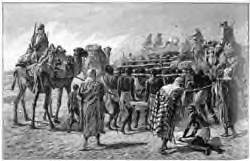
Over
28 Million Africans have been enslaved in the Muslim world during the
past 14 centuries
While
much has been written
concerning the Transatlantic slave trade, surprisingly little attention
has been given to the Islamic slave trade across the Sahara, the Red
Sea and the Indian Ocean. While the European involvement in the
Transatlantic slave trade to the Americas lasted for just over three
centuries, the Arab involvement in the slave trade has lasted fourteen
centuries, and in some parts of the Muslim world is still continuing to
this day.
CONTRASTS
IN CAPTIVITY
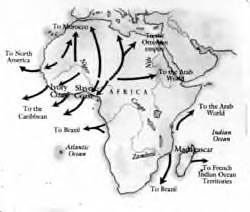
A
comparison of the Muslim slave trade to the American slave trade
reveals some interesting contrasts. While two out of every three slaves
shipped across the Atlantic were men, the proportions were reversed in
the Muslim slave trade. Two women for every man were enslaved by the
Muslims.
While
the mortality rate for
slaves being transported across the Atlantic was as high as 10%, the
percentage of slaves dying in transit in the Transsahara and East
African slave trade was between 80 and 90%!
While
almost all the slaves
shipped across the Atlantic were for agricultural work, most of the
slaves destined for the Muslim Middle East were for sexual exploitation
as concubines, in harems, and for military service.
While
many children were born to
slaves in the Americas, and millions of their descendants are citizens
in Brazil and the USA to this day, very few descendants of the slaves
that ended up in the Middle East survive.
While
most slaves who went to
the Americas could marry and have families, most of the male slaves
destined for the Middle East were castrated, and most of the children
born to the women were killed at birth.
It
is estimated that possibly as
many as 11 million Africans were transported across the Atlantic (95%
of which went to South and Central America, mainly to Portuguese,
Spanish and French possessions. Only 5% of the slaves went to the
United States).
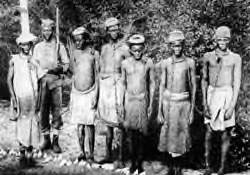
Slaves
in Africa - in the early 20th century.
However,
at least 28 million
Africans were enslaved in the Muslim Middle East. As at least 80% of
those captured by Muslim slave traders were calculated to have died
before reaching the slave markets, it is believed that the death toll
from the 14 centuries of Muslim slave raids into Africa could have been
over 112 million. When added to the number of those sold in the slave
markets, the total number of African victims of the Transsaharan and
East African slave trade could be significantly higher than 140 million
people.
THE
ABSENCE OF ARAB ABOLITIONISTS
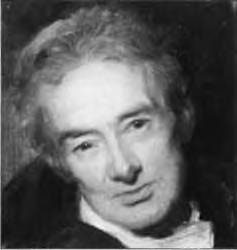
William
Wilberforce led the campaign against slavery for 59 years.
While
Christian Reformers
spearheaded the antislavery abolitionist movements in Europe and North
America, and Great Britain mobilized her Navy, throughout most of the
19th Century, to intercept slave ships and set the captives free, there
was no comparable opposition to slavery within the Muslim world.
Even
after Britain outlawed the slave trade in 1807 and Europe abolished the
slave trade in 1815, Muslim slave traders enslaved a further 2 million
Africans. This despite vigorous British Naval activity and military
intervention to limit the Muslim slave trade. By some calculations the
number of victims of the 14 centuries of Muslim slave trade could exceed
180 million.
Nearly
100 years after President
Abraham Lincoln issued the Emancipation Proclamation in America, and
130 years after all slaves within the British Empire were set free by
parliamentary decree, Saudi Arabia and Yemen, in 1962, and Mauritania
in 1980, begrudgingly removed legalized slavery from their statute
books. And this only after international pressure was brought to bear.
Today numerous international organizations document that slavery still
continues in some Muslim countries.
THE
PAGAN ORIGINS OF SLAVERY
Slavery
long predated
Christianity and many of the early Christians were slaves in the Roman
Empire. Without exception, the pre-Christian world accepted slavery as
normal and desirable. The Greek philosopher Aristotle claimed: "From
the hour of their birth, some are marked out for subjection, others for
rule." The great civilizations of Mesopotamia, Babylon, Egypt, Greece,
Rome, and all the civilizations in Central America and Africa were
built upon slave labor.
People
became slaves by being an
insolvent debtor, or sold into slavery by their parents, or by being
born to slave parents, or by being captured in war, or through
kidnapping by slave raiders and pirates. Slave dealing was an accepted
way of life, fully established in all societies. Most of these slaves
were white people, or Europeans. In fact the very word "slave", comes
from the people of Eastern Europe, the Slavs.
St.
Patrick, the English
missionary to the Irish, was once a slave himself, kidnapped from his
home and taken to Ireland against his will. Patrick spoke out strongly
against slavery. He wrote: "But it is the women kept in slavery who
suffer the most."
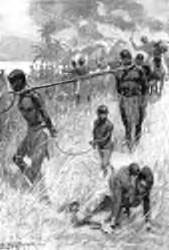
About
80% of those captured by Muslim slave raiders died before reaching the
slave markets.
The
Greeks, from whom we derive
so many modern, humanistic ideas, were utterly dependent on slavery.
Even Plato's Republic was firmly based on slave labor. Plato said that
50 or more slaves represented the possessions of a wealthy man.
Under
Roman law, when a slave
owner was found murdered, all his slaves were to be executed. In one
case, when a certain Pedanius Secundas was murdered, all 400 of his
slaves were put to death.
Before
the coming of Christ, the
heathen nations despised manual work and confined it to slaves. When
Christ was born, half of the population of the Roman Empire were
slaves. Three quarters of the population of Athens were slaves.
Slavery
was indigenous to
African and Arab countries before it made its way to Europe. Slavery
was widely practiced by the tribes of the American Indians long before
Columbus set foot on the shores of the New World. Ethiopia had slavery
until 1942, Saudi Arabia until 1962, Peru until 1968, India until 1976
and Mauritania until 1980. What is also seldom remembered is that many
black Americans in the 19th Century owned slaves. For example,
according to the United States census of 1830, in just the one town of
Charleston, South Carolina, 407 black Americans owned slaves
themselves.
THE
CHRISTIAN ROOTS OF LIBERTY
But
Jesus revolutionized labor.
By taking up the ax, the saw, the hammer and the plane, our Lord endued
labor with a new dignity. Christianity undercut slavery by giving
dignity to work. By reforming work, Christianity transformed the entire
social order.
Our
Lord Jesus Christ began His
ministry in Nazareth with these words: "The Spirit of the Lord is
on Me to proclaim freedom for the prisoners and release to the
oppressed." Luke 4:18
When
the apostle Paul wrote to
Philemon, concerning his escaped slave, he urged him to welcome back
Onesimus "no longer as a slave, but as a dear brother as a man and as a
brother in the Lord." Philemon 16.
Because
of these and other
Scriptural commands to love our neighbor, to be a good Samaritan and to
do for others what you would want them to do for you, Christians like
William Wilberforce, John Newton, William Carey, David Livingstone,
Lord Shaftsbury and General Charles Gordon worked tirelessly to end the
slave trade, stop child labor, and set the captives free.
From
the very beginning of the
Christian Church, Christians freed slaves. During the 2nd and 3rd
Centuries many tens of thousands of slaves were freed by people who
converted to Christ. St. Melania was said to have emancipated 8,000
slaves, St. Ovidius freed 5,000, Chromatius freed 1,400, Hermes 1,200.
Many of the Christian clergy at Hippo under St. Augustine "freed their
slaves as an act of piety." In AD 315, the Emperor Constantine, just
two years after he issued the edict of Milan, legalizing Christianity,
imposed the death penalty on those who stole children to bring them up
as slaves.
The
Emperor Justinian abolished
all laws that prevented the freeing of slaves. St. Augustine (354 -
430) saw slavery as the product of sin and as contrary to God's Divine
plan (The City of God). St. Chrysostom in the 4th Century, taught that
when Christ came He annulled slavery. He proclaimed "in Christ Jesus
there is no slave therefore it is not necessary to have a slave buy
them, and after you have taught them some skill by which they can
maintain themselves, set them free."
For
centuries, throughout the
Middle Ages, bishops and church councils recommended the redemption of
captive slaves, and for five centuries the Trinitarian monks redeemed
Christian slaves from Moorish (Muslim) servitude.
In
1102 AD, the London Church
Council outlawed slavery and the slave trade. By the 12th Century
slaves in Europe were rare, and by the 14th Century slavery was almost
unknown on the continent of Europe.
THE
MUSLIM SLAVE TRADE
However,
with the birth of Islam
came a rebirth of the slave trade. As Ronald Segal in "Islam's Black
Slaves" documents: "When Islam conquered the Persian Sassanid Empire
and much of the Byzantine Empire, including Syria and Egypt, in the 7th
Century, it acquired immense quantities of gold stripping churches and
monasteries either directly or by taxes, payable in gold, imposed on
the clergy and looting gold from tombs the state encouraged the search
and sanctioned the seizure, in return for a fifth of the finds."
Segal
notes: "Female slaves were
required in considerable numbers for musicians, singers and dancers
many more were bought for domestic workers and many were in demand as
concubines. The harems of rulers could be enormous. The harem of Abdal
Rahman III (912 - 961) in Cordoba contained over 6,000 concubines! And
the one in the Fatimid Palace in Cairo had twice as many."
An
Arab slave raid in East Africa 1888.
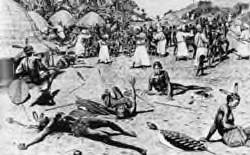
The death toll from 14 centuries of the Muslim slave
trade in Africa is estimated at over 112 million.
Islam's
Black Slaves also
reveals that the castration of male slaves was common place. "The
Caliph in Baghdad at the beginning of the 10th Century had 7,000 black
eunuchs and 4,000 white eunuchs in his palace." It was noted that there
were widespread "homosexual relations" as well. Islam's Black Slaves
notes that Islamic teachers throughout the centuries consistently
defended slavery: "For there must be masters and slaves." Others noted
that blacks "lack self-control and steadiness of mind and they are
overcome by fickleness, foolishness and ignorance. Such are the blacks
who live in the extremity of the land of Ethiopia, the Nubians, Zanj
and the like."
Ibn
Khaldun (1332 - 1406) the
preeminent Muslim medieval historian and social thinker wrote:
"The Negro nations are as a rule submissive to slavery because
they have attributes that are quite similar to dumb animals."
By
the Middle Ages, the Arab
word "abd" was in general use to denote a black slave while the word
"mamluk" referred to a white slave. Even as late as the 19th Century,
it was noted that in Mecca "there are few families that do not keep
slaves they all keep mistresses in common with their lawful wives." It
was noted that black slaves were castrated "based on the assumption
that the blacks had an ungovernable sexual appetite."
When
the Fatimids came to power
they slaughtered all the tens of thousands of black military slaves and
raised an entirely new slave army. Some of these slaves were
conscripted into the army at age ten. From Persia to Egypt to Morocco,
slave armies from 30,000 to up to 250,000 became commonplace.
Even
Ronald Segal, who is most sympathetic to Islam and clearly prejudiced
against Christianity, admits that well over 30 million black Africans
would have died at the hands of Muslim slave traders or ended up in
Muslim slavery.
A
dhow, the favorite slave carrying vessel of Arab slave traders.
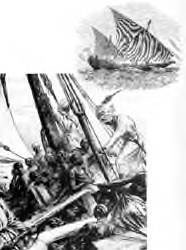
Arab
traders beat their cargo into submission on the run from the African
coast to Zanzibar.
The
Muslim slave trade took
place across the Sahara Desert, from the coast of the Red Sea, and from
East Africa across the Indian Ocean. The Transsahara trade was
conducted along six major slave routes. Just in the 19th Century, for
which we have more accurate records, 1.2 million slaves were brought
across the Sahara into the Middle East, 450,000 down the Red Sea and
442,000 from East African coastal ports. That is a total of 2 million
black slaves - just in the 1800's. At least 8 million more were
calculated to have died before reaching the Muslim slave markets.
Islam's
Black Slaves
records: "In the 1570's, a Frenchman visiting Egypt found many
thousands of blacks on sale in Cairo on market days. In 1665 Father
Antonios Gonzalis, a Spanish/Belgian traveler, reported 800 - 1,000
slaves on sale in the Cairo market on a single day. In 1796, a British
traveler reported a caravan of 5,000 slaves departing from Darfur. In
1838, it was estimated that 10,000 to 12,000 slaves were arriving in
Cairo each year." Just in the Arabic plantations off the East Coast of
Africa, on the islands of Zanzibar and Pemba, there were 769,000 black
slaves.
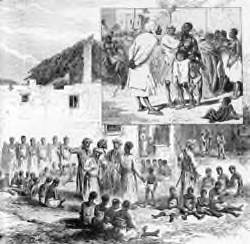
The
slave market in Zanzibar sold an average of 300 slaves every day.
In
the 19th Century, the East
African black slave trade included 347,000 slaves shipped to Arabia,
Persia and India; 95,000 slaves were shipped to the Arab plantations in
the Mascareme Islands.
Segal
notes "The high death rate
and low birth rate among black slaves in the Middle East and the
astonishingly low birth rate amongst black slave women" in North Africa
and the Middle East. "Muslim civilization lagged increasingly behind
the West in protecting public health. The arithmetic of the Muslim
black slave trade must also not ignore the lives of those men, women
and children taken or lost during the procurement, storage and
transport the sale of a single captive for slavery might represent a
loss of ten in the population from defenders killed in attacks on
villages, the deaths of women and children from related famine and the
loss of children, the old and the sick, unable to keep up with their
captors or killed along the way in hostile encounters, or dying of
sheer misery."
One
British explorer encountered over 100 human skeletons from a slave
caravan en route for Tripoli.
The
explorer, Heinrich Barth, recorded that a slave caravan lost 40 slaves
in the course of a single night at Benghazi.
The
British explorer, Richard
Lander, came across a group of 30 slaves in West Africa, all of them
stricken with smallpox, all bound neck to neck with twisted strips of
bullock hide.
One
caravan with 3,000
proceeding from the coast in East Africa, lost two thirds of its number
from starvation, disease and murder.
In
the Nubian desert, one slave caravan of 2,000 slaves literally vanished
as every slave died.
AN
EYEWITNESS ACCOUNT
In
1818, Captain Lyon of the
Royal Navy reported that the Al-Mukani in Tripoli "waged war on all its
defenseless neighbors and annually carried off 4,000 to 5,000 slaves a
piteous spectacle! These poor oppressed beings were, many of them, so
exhausted as to be scarcely able to walk, their legs and feet were much
swelled, and by their enormous size formed a striking contrast with
their emaciated bodies. They were all borne down with loads of
firewood, and even poor little children, worn to skeletons by fatigue
and hardships, were obliged to bear their burden, while many of their
inhuman masters with dreadful whip suspended from their waist all the
traders speak of slaves as farmers do of cattle the defenseless state
of the Negro kingdoms to the southward are temptations too strong to be
resisted, a force is therefore annually sent to pillage these
defenseless people, to carry them off as slaves, burn their towns, kill
the aged and infants, destroy their crops and inflict on them every
possible misery all slavery is for an unlimited time none of their
owners ever moved without their whips - which were in constant use
drinking too much water, bringing too little wood or falling asleep
before the cooking was finished, were considered nearly capital crimes,
and it was in vain for these poor creatures to plead the excuse of
being tired. Nothing could withhold the application of the whip. No
slaves dared to be ill or unable to walk, but when the poor sufferer
dies, the master suspects that there must have been something 'wrong
inside' and regrets not having liberally applied their usual remedy of
burning the belly with a red-hot iron."
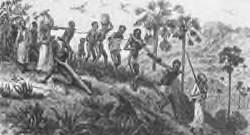
Arab
slave traders along the Ruvuma River, East Africa, 1866, ax a
straggler.
Records
for Morocco in 1876 show
that market prices for slaves varied from £10 ($48) to £30 ($140).
Female slaves comprised the vast majority of sales with "attractive
virgins" fetching between £40 to £80 ($192 - $386). It was reported
that "a considerable majority of the slaves crossing the Sahara were
destined to become concubines in North Africa, the Middle East and
occasionally even further afield."
CHRISTIAN
SLAVES - MUSLIM MASTERS
Segal
also observed that: "White
slaves from Christian Spain, Central and Eastern Europe" were also
shipped into the Middle East and served in the "palaces of rulers and
the establishments of the rich." He records that: "All Slavic eunuchs
are castrated in that region and the operation is performed by Jewish
merchants."
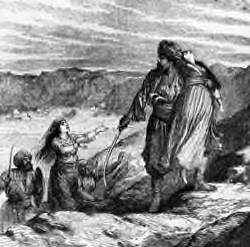
Muslim
slave raiders kidnapped women from Europe for harems in the Middle
East.
Historian
Robert Davis in his
book "Christian Slaves, Muslim Masters - White Slavery In the
Mediterranean, the Barbary Coast and Italy", estimates that North
African Muslim pirates abducted and enslaved more than 1 million
Europeans between 1530 and 1780. These white Christians were seized in
a series of raids which depopulated coastal towns from Sicily to
Cornwall. Thousands of white Christians in coastal areas were seized
every year to work as galley slaves, laborers and concubines for Muslim
slave masters in what is today Morocco, Tunisia, Algeria and Libya.
Villages and towns on the coast of Italy, Spain, Portugal and France
were the hardest hit, but the Muslim slave raiders also seized people
as far afield as Britain, Ireland and Iceland. They even captured 130
American seamen from ships they boarded in the Atlantic between 1785
and 1793.
According
to one report, 7,000
English people were abducted between 1622 to 1644, many of them ship
crews and passengers. But the Corsairs also landed on unguarded
beaches, often at night, to snatch the unwary. Almost all the
inhabitants of the village of Baltimore, in Ireland, were captured in
1631, and there were other raids in Devon and Cornwall. Many of these
white, Christian slaves were put to work in quarries, building sites
and galleys and endured malnutrition, disease and mistreatment at the
hands of their Muslim slave masters. Many of them were used for public
works such as building harbors.
Female
captives were sexually
abused in palace harems and others were held as hostages and bargained
for ransom. "The most unlucky ended up stuck and forgotten out in the
desert, in some sleepy town such as Suez, or in Turkish Sultanate
galleys, where some slaves rowed for decades without ever setting foot
on shore." Professor Davis estimates that up to 1.25 million Europeans
were enslaved by Muslim slave raiders between 1500 to 1800.
THE
EUROPEAN SLAVE TRADE
While
Islam dominated the slave
trade from the 7th to the 15th Century, between 1519 and 1815 Europe
also joined in this trade in human flesh. And it was those European
nations which had suffered the most at the hands of Muslim slave
raiders, and under centuries of Muslim military occupation, Spain and
Portugal, who dominated the European slave trade.
It
was the enemies of the
Reformation who brought Europe into this disgraceful trade. Emperor
Charles V (whom Martin Luther defied with his historic "My conscience
is captive to the Word of God here I stand I can do no other." speech)
of the Holy Roman Empire who first authorized Europe's involvement in
the slave trade in 1519. Because of Pope Alexander VI's Line of
Demarcation Bill of 1493 which barred Spain from Africa, Spain issued
Asientos (a monopoly) to other nations to supply slaves for her South
American colonies. First Portugal had this lucrative franchise, then
the Dutch, then the French. Finally, by the treaty of Utrecht 1713, the
Asientos was transferred from France to Britain. Britain's involvement
in slavery was first authorized in 1631 by King Charles I (who was
later executed by Parliament). His son, Charles II, reintroduced it by
Royal Charter in 1672.
According
to "The Slave Trade"
by Hugh Thomas, approximately 4 million (35.4%) went to Portuguese
controlled Brazil; 2.5 million (22.1%) to the Spanish nations of South
and Central America; 2 million (17.7%) to the British West Indies
(mostly Jamaica); 1.6 million (14.1%) to French West Indies; half a
million (4.4%) to Dutch West Indies and half a million (4.4%) to North
America.
THE
AMERICAN SLAVE TRADE
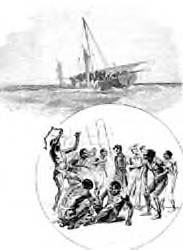
Slaves
freed by the British Navy.
It
is extraordinary that, considering that less than 5% of all the
Transatlantic slaves ended up in North America, the vast majority of
films, books and articles concerning the slave trade concentrate only on
the American involvement in the slave trade, as though slavery was a
uniquely American aberration. However, the vastly greater involvement of
Portugal, Spain and France seem to be largely ignored. Even more so the
far greater and longer running Muslim slave trade into the Middle East
has been so ignored as to make it one of history's best-kept secrets.
We
tend to focus on what
happened in North America because the United States would eventually
fight a war, in part over slavery, and because of the enormous and
vocal American opposition to slavery. This was in sharp contrast to the
indifference that Muslims, Africans and many Europeans evidenced
towards it.
THE
AFRICAN SLAVE TRADE
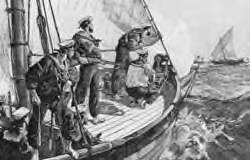
A
steam pinnache of H.M.S. London puts a warning shot across the bow of
a slaving dhow in 1881.
The
legends of European slave
raiders venturing into the jungles of Africa to capture free peoples
are generally just that: myths. The embarrassing fact of history, is
that the Europeans did not have to use any force to obtain these
slaves. The slaves were "sold" by their black owners. There was no need
for the slave raiders to risk their lives or venture into the jungles
of Africa, they simply purchased the people from African chiefs and
Muslim slave traders at the coast.
However,
while the slave trade
and slavery itself was always criticized vigorously in Britain and
America, no comparable criticism was evident in the Muslim Middle East
or amongst the African tribes which sold their own people, and
neighboring tribes, into slavery. Almost all of the African slaves
transported across the Atlantic were captured and sold by African
rulers and merchants.
Many
chiefs found it more
profitable to sell their enemies, criminals and debtors than to kill or
imprison them. Many were weaker neighboring tribes conquered for the
express purpose of selling their people into slavery. The disgraceful
fact is that there were three equally guilty partners in the crime of
the Transatlantic slave trade: pagan African chiefs, Muslim Arabs and
Christian Europeans.
The
Trade, as it became known,
involved a triangular voyage. Slave ships sailed from Bristol or
Liverpool loaded with cloths, beads, muskets, iron bars and brandy.
This merchandise was then traded in West Africa in exchange for slaves.
Mostly African chiefs sold their own people, or engaged in wars and
slave raids against neighboring tribes to capture victims for this
trade. Often professional Arab slave traders provided the victims.
The
middle passage transported
the slaves to the West Indies. Here the slaves were sold and the ships
loaded with spices, rum, molasses and sugar. The third leg of the
journey was the return to England. The average Englishman on the street
was kept in the dark as to what was actually happening on the middle
passage, until, in 1785, Thomas Clarkson's landmark study "Slavery and
Commerce In the Human Species" was first published at Cambridge.
According to Clarkson's research, 10% of the slaves would normally die
during the middle passage. Strong men would fetch as much as £40 while
the women and children were sold in cheap batches with the sick and
weak men. In England 18,000 people were employed simply on making the
goods to trade for slaves in Africa. This trade constituted 4.4% of
British exports.
WILBERFORCE'S
WAR
On
Sunday 28 October 1787,
William Wilberforce wrote in his diary: "God Almighty has set before me
two great objects, the suppression of the slave trade and the
Reformation of society." For the rest of his life, William Wilberforce
dedicated his life as a Member of Parliament to opposing the slave
trade and working for the abolition of slavery throughout the British
Empire.
On
22 February 1807, twenty
years after he first began his crusade, and in the middle of Britain's
war with France, Wilberforce and his team's labors were rewarded with
victory. By an overwhelming 283 votes for to 16 against, the motion to
abolish the slave trade was carried in the House of Commons. The
parliamentarians leapt to their feet with great cheers and gave
Wilberforce the greatest ovation ever seen in British history. William
bent forward in his seat, his head in his hands, tears of gratitude
streaming down his face.
In
1809, the British government
mobilized its Navy to search suspected slave ships, even foreign
vessels on the high seas. In 1810, the British Parliament declared
slave trading a felony, punishable by fourteen years hard labor. In
1814, the British representative at the Congress of Vienna insisted on
the abolition of the slave trade being included in the International
Treaty. This Treaty was signed by all the European powers on 9 June
1815. In 1825, Britain passed a bill making slave trading punishable by
death.
Finally,
just three days before
William Wilberforce died, by an Act of Parliament in 1833, the British
abolished slavery itself - setting all 700,000 slaves in British
overseas territories free. Wilberforce's lifetime campaign of 59 years
was now fully successful. "Thank God that I've lived to witness the day
in which England is willing to give 20 million pounds sterling for the
abolition of slavery!" he exclaimed. Within three days he died
rejoicing. (For the story of how slavery was abolished see the chapter
on William Wilberforce - Missionary to Parliament in The Greatest
Century of Missions).
The
"History of European Morals"
suggests that "the unwary, unostentatious and inglorious crusade of
England against slavery may probably be regarded as among the three or
four perfectly virtuous pages comprised in the history of nations."
The
abolition of slavery was one
of the great turning points in history. And the long and vigorous
crusade by the British Navy throughout the 19th Century against the
slave trade ranks as one of the most extraordinary and unselfish
applications of national policy ever seen in the history of nations.
"...where
the Spirit of the Lord is, there is freedom." 2 Corinthians 3:17
SET
FREE TO SERVE CHRIST
Rescued
from slavery by the British Navy, Samual Crowther became the first
African bishop of the Church of England.
One
of the many fruits of
William Wilberforce's life long crusade against the slave trade was
that Samuel Ajayi Crowther, who was born in 1807 (the year Great
Britain abolished the slave trade) in Yorubaland (modern Western
Nigeria) was rescued by a British naval squadron. When Samuel was just
thirteen years old, he was captured by Muslim slave traders for
transport across the Atlantic, but rescued by the Navy. Samuel received
an education in Sierra Leone, where he was converted to Christ, and
after further education in England he was ordained as a minister of the
Church of England for service with the Church Missionary Society.
Newly
liberated slaves in Zanzibar.
Samuel
participated in the
expedition up the Niger River Valley to overcome the ravages of the
slave industry still entrenched there. Of the 145 Europeans on that
expedition, 130 were struck down with Malaria, and 40 died. Yet the
expedition succeeded in establishing a Missionary Center at Fourah Bay
for training liberated slaves to evangelize West Africa. It was built
on the very place where a slave market had once stood. The rafters of
the roof were made almost entirely from the masts of old slave ships.
Samuel
Crowther was one of the
first four students to graduate from Fourah Bay's College, Sub-Saharan
Africa's first university. In 1864, Samuel Crowther was ordained as the
first African Bishop of the Church of England in an overflowing
Canterbury cathedral. Today there are eighteen times more Anglicans
worshipping in church every Sunday in Nigeria than there are in Great
Britain.
LIVINGSTONE'S
TRAVELS
Livingstone
and his team free slaves from Arab slave raiders in the Shire Valley.
However,
as the British Navy was
defeating the slave trade in the Atlantic, the East African slave trade
was increasing. It was missionary explorer David Livingstone whose
graphic descriptions brought the ravages of the East African slave
trade to light. His Missionary Travels and Narrative of an Expedition
to the Zambezi exposed the horrors of the slave trade: "Two of the
women had been shot the day before for attempting to untie their
thongs. One woman had her infants brains knocked out because she could
not carry her load and it; and a man was dispatched with an ax because
he had broken down with fatigue those taken out of the country are but
a very small section of the sufferers. We never realized the atrocious
nature of the traffic until we saw it at the fountain head. 'There
truly Satan has his seat.' Besides those actually captured thousands
are killed and die of their wounds and famine, driven from their
villages by the internecine war waged for slaves with their own
clansmen and neighbors, slain by the lust of gain, which is stimulated,
be it remembered always, by the slave purchases of Cuba and elsewhere."
A
TRADE IN HUMAN MISERY
The
British and Foreign
Antislavery Society reported that most slaves were captured in the Lake
Niassa area (Malawi and Mozambique), the Bahr El Ghazal region and in
areas of Ethiopia. Slaves were taken to East African markets like
Zanzibar, Kilwa and Quelimane and then shipped to Turkey, India, Saudi
Arabia, Yemen, Oman, Iraq, Iran and to the islands of Pemba, Reunion
and Madagascar.
The
Antislavery Reporter
estimated the Muslim slave trade as exporting 63,000 slaves per year.
Some estimates went as high as 500,000 slaves exported in a single
year. One researcher, Ralph Austen calculated that between 1830 and
1861 imports of slaves to the Persian Gulf averaged 3,700 to 3,100 per
annum. This same researcher noted that about 8,855 slaves a year were
retained as slaves on the East African coast as slaves of African slave
masters.
1833
- All slaves in the British Empire are set free by Parliamentary
decree.
Few
authors dared describe the
horrors involved in the Transsahara slave trade: kidnapping and
castrating young boys to be sold as eunuchs ("the living dead") in the
homes of wealthy Arab landlords and force marching young women across
endless miles of scorching sand in the Sahara desert to become slave
concubines, most dying in transit. The Muslim slave trade typically
dealt in the sale of castrated male slaves: eunuchs. Eunuchs were
created by completely amputating the scrotum and penis of eight to
twelve year old African boys. Hundreds of thousands of young boys bled
to death during this gory procedure. The survival rate from this
process ranged from 1 in 10 to 1 in 30. These castrated boys brought
the highest price at the slave market.
SHARIA
LAW AND SLAVERY
Islam's
Black Slaves notes: "the
Quran stipulated that female slaves might lawfully be enjoyed by their
masters." Mo-ham-mad himself owned many slaves, some of whom he
captured in wars of conquest and some he purchased. The names of forty
slaves owned by Mo-ham-mad are recorded by Muslim chroniclers. Islamic
law (Sharia) contains elaborate regulations for slavery. A slave had no
right to be heard in court (testimony was forbidden by slaves), slaves
had no right to property, could marry only with the permission of the
owner, and were considered to be chattel, that is the movable property,
of the slave owner. Muslim slave owners were specifically entitled by
Sharia law to sexually exploit their slaves, including hiring them out
as prostitutes.
One
reason why very little has
been written about the Arab involvement in slavery is that traditional
Muslim culture still condones slavery. The Sharia, the codified Muslim
law which is based upon the teachings and example of Mo-ham-mad,
contains explicit regulations for slavery. One of the primary
principles of Islam is following the example of Mo-ham-mad. Whatever
Mo-ham-mad did, we must do, what he forbade, we must forbid, what he
did not forbid, we may not forbid. As Mo-ham-mad himself traded in
slaves and owned slaves, accumulating multiple wives, even marrying a
six year old, and having concubines - slavery and the sexual
exploitation of women is deeply ingrained in Muslim tradition. Muslim
nations had engaged in the slave trade for over 600 years before Europe
became involved in the Transatlantic slave trade.
SLAVERY
TODAY
Almost
200 years after the
British outlawed the slave trade in 1807, slave raids and the sale of
slaves in Muslim markets continues in countries like Sudan. The slave
trade remained legal in Saudi Arabia until 1962, when under
international pressure it was finally abolished. However, there are
persistent, credible reports, that slavery persists in Saudi Arabia,
and even that slaves from Sudan are ending up in Saudi Arabia.
Recently,
a
former slave from the Nuba Mountains of Sudan, Mende Nazer, had her
autobiography: "Slave: My True Story" published. Mende was captured in
1992, she was first a slave to a rich Arab family in Khartoum, and then
in 2002 to a Sudanese diplomat in London, from whom she escaped and
sought political asylum.
THE
LAW OF LIBERTY
Although
the Old Testament
provided for slavery for criminals and insolvent debtors, kidnapping
and enslaving law-abiding people incurred the death penalty. "Anyone
who kidnaps another and either sells him or still has him when he is
caught must be put to death." Exodus 21:16
The
New Testament expressly
forbids both the slave trade and slavery itself. ".the Law is made not
for the righteous but for Law breakers for those who kill their fathers
or mothers, for murderers, for adulterers and perverts, for slave
traders and liars and perjurers." 1 Timothy 1:9-10
"There
is neither Jew nor Greek, slave nor free for you are all one in Christ
Jesus." Galatians 3:28
"From
one man He made every nation of men." Acts 17:26
"Love
the Lord your God with all
your heart, with all your soul and with all your mind and with all your
strength love your neighbor as yourself." Mark 12:30-31
"Then
you will know the truth and the truth will set you free." John 8:32
"...where
the Spirit of the Lord is, there is freedom." 2 Corinthians 3:17
"...proclaim
liberty throughout the land." Leviticus 25:10
Dr.
Peter Hammond is the author of Faith Under Fire In Sudan and The
Greatest Century of Missions.
BIBLIOGRAPHY
A
History of Christianity, by Kenneth Scott Latourette, Harper, 1953
Christian
Slaves, Muslim
Masters: White Slavery in the Mediterranean; the Barbary Coast and
Italy 1500 - 1800, by Robert Davis, Palgrave MacMillan, 2004
God's
Politician, by Garth Lean, Helmers and Howard, 1987
History
of Slavery, by Suzanne Everett, Chartwell, 1997
Islam's
Black Slaves, by Ronald Segal, Farrar, New York, 2001
Missionary
Travels and Researches in South Africa, by David Livingstone, London,
1857
Narrative
of an Expedition to the Zambezi, by David Livingstone, London,1865
The
Greatest Century of Missions, by Peter Hammond, CLB, 2002
The
Slave Trade, by Hugh Thomas, 1997
Under
the Influence - How Christianity Transformed Civilization, by Alvin
Schmit, Zondervan, 2001

The Unknown Slavery: In the Muslim world, that is
— and it's not over
John J. Miller
When Henry Morton Stanley explored the Congo River's Boyoma
Falls, the cascades weren't the only thing he noticed: "Every three or
four miles we came in view of the black traces of the destroyers. The
scarred stakes, poles of once populous settlements, scorched banana
groves, and prostrate palms, all betokened ruthless ruin."
The perpetrators of this wreckage were slavers. As late as
1883 -- when Stanley wrote -- they were scouring the African countryside
for people they could seize and haul into bondage. Their gruesome search
destroyed whole villages, leaving once-prosperous areas devoid of
inhabitants. Their forced marches to the coast were ghastly, with the
exposed bones of captives who died along the way so numerous they
practically served as trail markers. Those who survived the ordeal --
fewer than half, by some estimates -- were exported to the world's final
repository of slavery: the Islamic world.
The phenomenon of Muslim slavery is not often studied, and
especially not the Muslim enslavement of black Africans. "A list of
serious scholarly monographs on [Islamic] slavery -- in law, in
doctrine, or in practice -- could be printed on a single page," wrote
Princeton's Bernard Lewis in his pioneering but brief book Race and
Slavery in the Middle East (1990). He went on to suggest that the
subject is so "highly sensitive" that it would be "professionally
hazardous" for young scholars to take it up. Indeed, among the thousands
of professors and graduate students affiliated with Middle Eastern
studies programs in the U.S., only a handful have dared to broach the
controversial topic, and a comprehensive history and analysis of it
remains to be written.
This stands in stark contrast to the huge amount of
scholarship on slavery in the West. Judging by the sheer volume of
material, one might come away with the mistaken impression that nowhere
was the vile institution of slavery more entrenched than among the
American hypocrites who declared that all men are created equal. And yet
throughout Muslim history, starting with Mohammed himself, slavery was a
vigorous and central part of Islamic civilization. This is not to say
Islamic slavery was worse than American slavery; in many ways, life was
easier under Muslim owners than under Mississippi owners. The problem,
rather, is that the Islamic world has not experienced the same kind of
moral reckoning on slavery that the West has. Muslim countries proved
extremely resistant to abolition; many of them had to be dragged into it
by the European colonial powers. It is hard to imagine a serious person
calling for America to enslave its enemies. Yet a prominent Saudi
cleric, Shaikh Saad Al-Buraik, recently urged Palestinians to do exactly
that with Jews: "Their women are yours to take, legitimately. God made
them yours. Why don't you enslave their women?"
Words are one thing, and actions another. Even today, however,
Islamic abolition cannot be called a complete success: Slavery continues
to be practiced in at least two nations whose regimes claim to derive
their legitimacy from Islam. These nations are Mauritania and Sudan, and
Muslims remain virtually silent about the practices of their
coreligionists there.
Slavery is an ancient institution, as old as recorded history.
Aristotle defended it; both the Old and New Testaments accept it as a
feature of the human condition. The Koran takes a similar view -- though
it also encourages (without commanding) slaveholders to treat their
slaves well, and urges (without requiring) their release. In Islamic
theology, slave ownership is a morally neutral act, but God smiles on
those who give slaves their liberty.
The characteristics of Muslim slavery have been far from
uniform over the centuries, but it is possible to identify a few general
traits. For starters, slaves were accorded more legal protections in the
Islamic world than they received almost anywhere else. Slavery came
under an intricate set of regulations that, for example, forbade the use
of slaves as prostitutes, and prevented mothers and young children from
being separated. The act of enslavement also wasn't supposed to occur on
Muslim soil, though the slavers and their customers didn't always pay
close attention to this rule. In the 19th century, Captain G. F. Lyon of
the Royal Navy described slaveholding in Libya: "They seize on the
inhabitants of whole towns where the only religion is that of the Koran,
and where there are mosques; and this is without scruple or remorse."
There was plenty of cruelty -- slavery, of course, always
involves cruelty -- but many chattels of Muslims were essentially
domestic workers who functioned as surrogate members of the master's
family. "Slaves in Islam were directed mainly at the service sector --
concubines and cooks, porters and soldiers -- with slavery itself
primarily a form of consumption rather than a factor of production,"
writes Ronald Segal in Islam's Black Slaves. Perhaps the most important
difference between slavery in the West and slavery in Islam is a
demographic one: Two-thirds of the slaves transported across the
Atlantic were male, and two-thirds of those involved in the Muslim trade
were female.
Over time, sub-Saharan Africa became the principal source of
involuntary labor. Muslims were not the first people to enslave black
Africans -- the ancient Egyptians had done it -- but they were the first
to engage in it systematically on a massive scale. Going back to Islam's
birth in the 7th century, historian Raymond Mauvy estimates that 14
million black slaves have been sold to Muslims. (This compares to Paul
E. Lovejoy's estimate of 10 to 11 million Africans shipped in chains to
the Western Hemisphere between 1650 and 1900; the vast majority of them
were sent to Latin America and the Caribbean, and half a million to
British North America and the U.S.) The journey from the slave's
homeland to the Middle East was often a treacherous one, especially when
it involved enduring the blistering heat of a Sahara crossing. Yet the
march was dangerous everywhere -- an Islamic version of the brutal
Middle Passage. The dead frequently outnumbered the survivors on these
journeys, often by a lot. Slavers accepted the high casualty rates
because their business was so lucrative. "It is like sending up to
London for a large block of ice in the summer," wrote a 19th-century
missionary in what is now Tanzania. "You know that a certain amount of
it will melt away before it reaches you . . . but that which remains
will be quite sufficient for your wants."
The oddest aspect of Islamic slavery was the eunuch. Castrated
male slaves became exceedingly popular in the Middle East sometime after
the rise of Islam. They are best known for serving as harem guards, but
they were also mosque custodians, administrators, and teachers. Eunuchs
were bought and sold at a premium, in part because their grisly
operation resulted in many fatalities. Their popularity remains
something of a mystery. "One can only speculate that eunuchs were
regarded as likely to be more devoted and dependable in serving their
masters than other males, with normal distractions, would be," writes
Segal. Whatever the reason, eunuchs became fixtures of Muslim culture.
Islam teaches against physical mutilation, so Muslims found themselves
searching for loopholes. Many eunuchs were castrated in non-Muslim
territory immediately before importation, in the belief that this
somehow kept Islamic land pure; a business in commercial castration thus
developed along the fringes of the Muslim world. (Prague is said to have
specialized in this during the period when Islam imported many slaves
from Europe.) Muslims later accepted castration within their own lands,
so long as non-Muslims performed the deed.
Slavery, in short, was an ingrained part of Islamic culture --
and it might still have been one today, but for European insistence that
Muslims end it. As recently as 1878, the holy cities of Mecca and Medina
served as major slave markets, trading 25,000 slaves annually. The
eradication of slavery, in fact, is one of the great and unheralded
legacies of colonialism.
The first Islamic countries to abolish slavery -- Tunisia,
Egypt, the Ottoman Empire -- did so under pressure from the West. Others
were more obstinate. In East Africa, slavery continued until after World
War I. Its persistence into the 20th century explains why the League of
Nations prioritized the abolition of slavery, even though doing so must
have seemed an anachronism to unsuspecting Westerners. It wasn't until
the start of World War II that Ethiopia and Liberia had gotten rid of
slavery. Later still, the U.N.'s Declaration of Human Rights condemned
slavery -- again, because the Islamic world had failed to wipe it out.
In 1953, sheikhs from Qatar attending the coronation of Queen Elizabeth
II included slaves in their retinues, and they did so again on another
visit five years later. Saudi Arabia and Yemen didn't get around to
abolishing slavery until 1962; three years later, a special report by
the U.N. reported that the Saudi royal family continued to keep hundreds
in bondage.
Mauritania outlawed slavery in 1980, apparently because its
two earlier prohibitions (in 1905 and 1960) were ignored. Today, it is
illegal for Mauritanians to say that slavery exists in their country --
a sure sign that it really does. By some estimates, at least 100,000 of
Mauritania's 2.7 million people continue to live in unpaid servitude,
most of them blacks toiling for light-skinned Moorish masters. Slavery
goes back centuries in Mauritania, and there's a long tradition of
slaves' working for the same family across generations. Apologists say
that those who remain in this capacity aren't slaves at all, but
servants who volunteer to trade their labor for room and board. Yet
these claims are effectively rebutted by a small group of escapees who
have delivered powerful personal testimonies of beatings and bondage.
Reliable information on what's really happening in Mauritania is hard to
come by because the Islamic government won't allow investigations.
Foreign journalists must travel in the company of the secret police and
face expulsion if they ask too many questions. In January, the
government banned the main opposition party, which has demanded
slavery's eradication. Mauritania has far to go before slavery ceases
within its borders.
Sudan has received considerably more attention than
Mauritania. In April, an organization affiliated with the Boston-based
American Anti- Slavery Group made headlines by purchasing 3,000 slaves
at $33 apiece and releasing them, and also negotiating the release of
3,000 others. Another group, the Swiss-based Christian Solidarity
International, says it has bought freedom for 60,000 slaves in Sudan
over the last several years. (This raises a separate question: Does
buying slaves from modern-day slave traders wind up perpetuating their
wretched business?) As with Mauritania, there are no truly credible
numbers describing the extent of the problem. Sudan has engaged in
slaving and slaveholding for ages; the current wave seems to have begun
in 1983, with the imposition of Islamic law. Following the 1989 coup by
the Islamofascist general Omar el-Bashir, the government became actively
involved in arming the slavers and supporting their operations in the
southern part of the country, where Muslims are outnumbered by
Christians and other non-Muslims. These slavers' methods are especially
vicious: The men are shot, the women and girls are sold into
concubinage, and the boys are fortunate if they become unpaid cattle
herders.
In considering the history of slavery in Islam and in the
West, it is a mistake to decide that one branch of the same evil
represents the greater sin. Instead, it is probably enough to say the
human toll in both places was horrible: Call it "immoral equivalence."
But there's an important difference today. The United States finds
itself apologizing for slavery (at least when Bill Clinton visits
Africa), handing out huge amounts of foreign aid (partly from a sense of
guilt), and giving at least passing thought to financial reparations for
the descendants of its own slaves. Yet when Muslim countries gather at
international forums, they discuss none of this -- and instead spend
their time writing resolutions bashing Israel and the West. They appear
to feel no remorse for the past, and no responsibility for the present.
While the West has its problems, it does not have this one.
Smuggled Boys Await
Return to Families
From Times Wire Reports -
2005
Dozens of Pakistani children who had been smuggled to the United Arab
Emirates to work as jockeys in camel races have returned home, an
official said.
The 86 children, some as young
as 4, had been in the United Arab Emirates for three to seven years,
said Faiza Asghar, an advisor on child rights issues with the Punjab
provincial government in eastern Pakistan.
The boys, with their identity cards hanging from their necks, arrived
in the provincial capital, Lahore, on a flight from Abu Dhabi and were
driven to a government shelter, Asghar said. The government will
attempt to reunite them with their families.
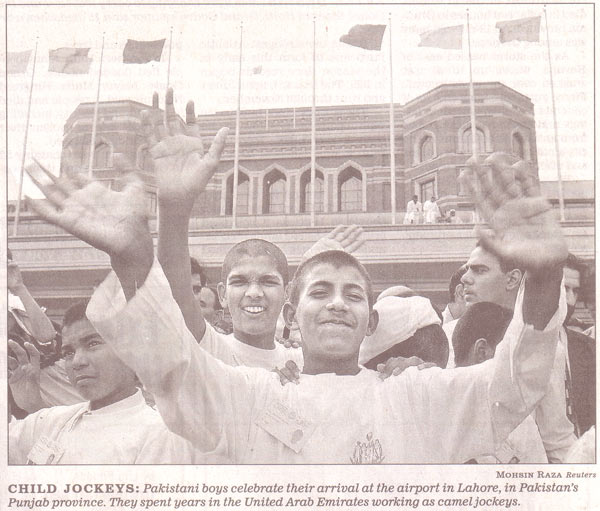
Slave-girls as sexual property in the Quran
October 20th, 2005
The Quran makes women subordinate to
men in
many ways.
But no women subject to the rule of Quranic law are more unfortunate
than slave girls. According to the eternal and unchanging scripture of
Islam, men are permitted to treat them as sexual property regardless
of their wishes, under certain specified circumstances.
Sura (Chapter) 23 of the Quran was
revealed during Muhammad’s life in Mecca before his Hijrah or
Emigration from his home city to Medina in AD 622. During the early
years of his ministry, he never waged war on anyone, so these were
times of peace, although he suffered from a measure of persecution.
[1]
The Quran in Sura 23:5-6 says:
5 [Most certainly true believers] . .
. guard their private parts scrupulously, 6 except with regard to
their wives and those who are legally in their possession, for in that
case they shall not be blameworthy. (Sayyid Abul A’La Maududi, The
Meaning of the Quran, vol. 3, p. 237)
The key words are “those who are
legally in their possession.” Maududi (d. 1979) is a highly respected
commentator on the Quran, and he interprets the plain meaning of the
clause, saying that sex with slave-girls is lawful.
Maududi writes:
Two categories of women have been
excluded from the general command of guarding the private parts: (a)
wives, (b) women who are legally in one’s possession, i.e.
slave-girls. Thus the verse clearly lays down the law that one is
allowed to have sexual relation with one’s slave-girl as with one’s
wife, the basis being possession and not marriage. If marriage had
been the condition, the slave-girl also would have been included among
the wives, and there was no need to mention them separately. (ibid. p.
241, note 7)
The main point in this section, which
Maududi overlooks or refuses to criticize, is that Muhammad himself
endorses not only the entire institution of slavery, but also sex
between male owners and their female slaves within this institution.
No devout Muslim can criticize the Prophet.
It should be noted that Sura 70:29-30,
also revealed in Mecca, uses words nearly identical to Sura 23:5-6.
Men must guard their private parts from everyone but their wives and
slave-girls, meaning that men may have sex with both “categories”
(Maududi’s word). [2]
At the time Sura 4, where our next
Quranic verse is found, is revealed, Muhammad had emigrated from
Mecca to Medina, and had fought many wars and skirmishes. For example,
he fought the Meccans in the Battle of Badr in AD 624 and again
the Meccans at the Battle of Uhud in AD 625. He also exiled the Jewish
tribes of Qaynuqa in AD 624 and Nadir in AD 625. He carried forward
this policy of sex between male owners and their female slaves to his
new city of Medina, with the added twist of enslaving women
prisoners of war and permitting his soldiers to have sex with them.
[3]
The Quran in Sura 4:24 says:
And forbidden to you are wedded wives
of other people except those who have fallen in your hands (as
prisoners of war) . . . (Maududi, vol. 1, p. 319). (See also Suras 4:3
and 33:50)
Thus, women captives are sometimes
forced to marry their Muslim masters, regardless of the marital status
of the women. That is, the masters are allowed to have sex with the
enslaved human property.
Maududi says in his comment on the
verse that is it lawful for Muslim holy warriors to marry women
prisoners of war even when their husbands are still alive.
But what happens if the husbands are captured with their wives?
Maududi cites a school of law that says Muslims may not marry them,
but two other schools say that the marriage between the captive
husbands and wives is broken (note 44).
But why would a debate emerge over
this cruelty? The answer is obvious for those who understand simple
justice. No marriage should take place between married prisoners of
war and their captors. In fact, no sex should take place between women
captives and their captors.
Predictably, the hadith perpetuate
this Quran-inspired immorality.
The hadith are the reports of
Muhammad’s actions and words outside of the Quran. The most reliable
collector and editor is Bukhari (d. 870).
The hadith demonstrate that Muslim
jihadists actually have sex with the captured women, whether or
not they are married. In the following passage, Khumus
is one-fifth of the spoils of war.
Ali, Muhammad’s cousin and son-in-law,
just finished a relaxing bath. Why?
The Prophet sent Ali to Khalid to
bring the Khumus (of the booty) and . . . Ali had taken a
bath (after a sexual act with a slave-girl from the Khumus).
What was Muhammad’s response to the
person who hated Ali for this sexual act?
Do you hate Ali for this? . . . Don’t
hate him, for he deserves more than that from [the] Khumus.
(source:
Bukhari)
Muhammad casually mentions that
slave women who are part of the one-fifth of the spoils of war can be
treated like sexual property. Ali is a Muslim hero. He was the husband
of Fatima, Muhammad’s daughter by his first wife Khadija. After all,
slaves are fair sexual game. The Quran says so.
Some things, however, are forbidden.
Holy jihadists may not practice coitus interruptus with the
women they capture. Babies must be fathered, regardless of the
preference of the man. The woman, of course, has no say in the matter
whatsoever.
While on a military campaign and away
from their wives, Muslim jihadists “received captives from among the
Arab captives and we desired women and celibacy became hard on us and
we loved to do coitus interruptus.” They asked the Holy Prophet about
this, and he invoked the doctrine of fate:
It is better for you not to do so
[practice coitus interruptus]. There is no person that is destined to
exist, but will come to existence, till the Day of Resurrection. (Bukhari ; for
parallel hadiths go
here and
here)
That is, these enquiring Muslims
should stop doing coitus interruptus, but instead go all the
way with the enslaved sex objects. Fate controls who should be born.
Comparisons
It is one thing for some soldiers in
any army to strike out on their own and rape women. All armies have
criminal soldiers who commit this wrong act. But it is quite another
to codify rape in a sacred text. Islam codifies and legalizes rape. It
is disappointing that the Quran does not abolish this sexual crime in
the clearest terms: Thou shalt not have sex with slave-girls under any
circumstance!
It may be argued that American
slave-owners committed sexual crimes against their slaves before the
Civil War (1861-1865), so who are Christians or Americans (the two are
not identical) to complain about Islam?
But the two situations are different.
It is wrong to compare the US slave states with the Muslim community
founded by Muhammad, who claimed divine inspiration. Instead, it is
best to compare the founder of a religion (Jesus) with another founder
(Muhammad). Second, in no place in the New Testament does God give
permission to men—Christian or secular—to have sex with slave-girls.
This would violate the spirit of Jesus’ ministry and the entire
writings of the New Testament authors. If Americans in a bygone era
did this, then they were not following God’s law. Moreover, a long and
bloody Civil War was fought which ended the practice.
The Quran, however, codifies and
legalizes this sexual crime for all time and every place that Islam is
able to dominate. No significant reform movement within Islam
questions the universal applicability of the laws it proclaims. Sharia
law based on the Quran is on the march, replacing British Common Law
in parts of Nigeria, and its application is demanded by Muslim
populations from Malaysia to Canada.
Ignorance of the law, as they say, is
no defense.
Notes
[1] For more information on the
historical and the literary topical contexts of Sura 23, click
here.
[2] If readers would like to inspect
these verses in multiple translations from the original Arabic, they
should go to this
website, which has three translations, and
this one, which is funded by the Saudi royal family.
[3] (For more information on the
historical and literary topical contexts of this next sura, please
click
here.)
Supplemental Material
This article quotes
the Quran and many hadith passages on sex with women prisoners of war.
It also analyzes modern Muslim scholars on the topic. They support
this practice. In Appendix One, the author answers a Muslim charge
that the Old Testament allows this practice.
This
article provides further details on Muhammad’s encouragement to
his soldiers to “do it” with women prisoners of war.
For information on Muhammad’s
“convenient” and “special” marriage privileges, see this short
article.
This
article demonstrates that Muhammad owned slaves.
This online
booklet cites many passages in the Quran and hadith, surveying
women’s place in Islam. The facts lead to one conclusion: Islam does
not honor women.
As for slavery generally, this
article demonstrates that Muslims practiced the slave trade. The
article tracks this dirty business up to today in the Islamic world.
This short
article contrasts Islam and Christianity on slavery.
This is an overview
article on slavery in Islam.
This
webpage has many links to articles and online booklets on
women in Islam and Christianity.
This
page in an online index refers to many articles and
Quranic passages on slavery.
Couple
Accused Of Enslavement Sued For $62,000
Dec 9, 2005 10:02 pm US/Mountain
Rick Sallinger
Reporting (CBS4)
AURORA, Colo.
The U.S. Department
of Labor is suing a Saudi man and his wife from Aurora who are accused
of enslaving their maid.
Homaidan Al-Turki is accused in federal and state court of crimes
ranging from kidnapping to sexual assault. His wife, Sarah Khonaizen
faces separate charges.
The suit against the couple is for more than $62,000 in back wages on
behalf of the maid who is from Indonesia.
On their website al-turki.com, in both Arabic and English, it claims
the maid said her treatment was 'excellent and that she was treated as
a member of the family and she had never been abused or sexually
assaulted.'
A press release on the site stated the maid's passport and salary were
being held at her request until she left the country. It adds:
'It is the same custom followed in the kingdom of Saudi Arabia where
families will help the housemaids save their money.'
In court files, Al-Turki's lawyers claim he has been the object of a
terrorist-related investigation for the past several years. That could
be the beginning of a defense in which he claims they couldn't get him
on that so now they are trying to get him on this.
"The problem with this defense is it's an American jury and American
jurors are going to say to themselves 'wait a minute, that is not the
custom in this country,'" said CBS4 legal analyst Andrew Cohen.
Al-Turki told CBS4 why he believes he is being prosecuted.
"I am Saudi, I am a Muslim and I think that's the ingredients to law
enforcement," Al-Turki said.
On the website, there are pictures of him and his family and a claim
that this case has 'ignited an outrage towards the Americans back in
Saudi Arabia.'
Khonaizen, Al-Turki's wife, is accused in Arapahoe County on a new
charge of violating the terms of her bond by having contact at a
mosque with witnesses in her case.
Because of the violation, immigration authorities are seeking an
increase in her bond.
The couple will go on trial next April in federal court.
Domestic
prisoner prevails
Girl
forced into servitude recounts her story in court; Irvine captors get
prison terms.
By GREG HARDESTY
Tuesday, October 24, 2006
The Orange County Register
When
authorities found her, the 12-year-old girl was shabbily dressed with
reddish hands caked with dead, hard-looking skin – the result of being
forced to work as a domestic servant for a large Irvine family.
Monday,
at the culmination of Orange County's first federal prosecution of a
human-trafficking case, the girl, now 17 and in a caring home, told a
judge how she lost nearly two years of her childhood.
"Where
was their love when it came to me?" the teen said, sobbing. "I was a
human being, too."
Just
a few feet away, the couple who treated her like an outcast in their new
home in a gated community, forcing her to care for their five children
and do housework for no pay, somberly awaited sentencing.
"What
they did to me will scar me for the rest of my life," said the girl,
Shyima. The Register is identifying her only by her first name at the
request of her foster parents. "They treated me like nothing."
At
the end of the emotional, two-hour hearing in Santa Ana, U.S. District
Judge James V. Selna sentenced the pair to prison and ordered them to
pay the girl more than $152,000 in restitution – the amount, plus
penalties, that prosecutors calculated she would have made working seven
days a week for 20 months.
After
expressing remorse through an Arabic translator, Abdel Nasser Youssef
Ibrahim, 45, was sentenced to three years in federal prison.
His
former wife, Amal Ahmed Ewis-Abd El Motelib, 43, who also apologized to
the court for her treatment of the girl, was sentenced to 22 months.
"What
happened was due to my ignorance of the law," Motelib told the judge.
In
a plea deal with prosecutors, she and Ibrahim pleaded guilty to four
felonies, including conspiracy and holding a person in involuntary
service through force, for keeping the girl in their home against her
will from August 2000 to April 2002.
Ibrahim
was ordered to surrender to authorities on Oct. 30, and Motelib on Nov.
13, but agents with the U.S. Immigration and Customs Enforcement took
them into custody immediately after sentencing for deportation
proceedings. Both will be deported to Egypt after they serve their
sentences, said William J. Hayes, a special agent with ICE in Santa Ana.
"I
hope this brave and courageous child encourages others who may be in
similar situations to come forward," Hayes said outside court.
Shyima,
who comes from an impoverished family, began working in the couple's
home in Egypt when she was 9.
According
to court documents, the couple caught her sister – also employed in
their home – stealing. They threatened to turn her over to authorities
unless Shyima came with them to the United States as their domestic
servant.
They
struck a deal with her parents, essentially leasing her for $30 a month
for a planned 10 years.
What
transpired in Irvine was a modern-day saga of child slavery, according
to court documents and an interview with Shyima.
Shyima
was not allowed to go to school and was refused visits to the doctor.
She
was relegated to a 12-by-8-foot converted room in the garage and forced
to sleep on a dirty, fold-up mattress. She had no dresser, no closet, no
heating or ventilation and only a black widow spider for a companion.
Every
morning, Shyima would wake up the three youngest children and dress
them. She would make their breakfast and pack their lunches for school
while Ibrahim and Motelib slept.
While
the other children in the household went to school, played with friends
and visited the mosque, Shyima was shunned. She was not allowed to eat
with the family and was verbally abused. Family members called her "the
Stupid Girl," among other names.
Shyima
was forced to hand-wash her clothes separately, in a soapy bucket she
kept by her mattress.
On
at least one occasion, Ibrahim slapped her for disobeying, and Motelib
slapped her at least twice.
They
told her she would be arrested if she went outside alone.
One
day, a neighbor saw her taking out the trash and asked her why she was
not in school. An anonymous phone call tipped off authorities.
Defense
lawyers argued that in Egypt it is customary to employ children as
domestic help. Laws there prohibit employing children 12 and under.
Ibrahim
and Motelib said in court papers that their conduct was motivated by a
"well-intentioned, charitable desire to care for and support the
children of an impoverished Egyptian family."
Two
of their five children, both adults, have been deported to Egypt; the
others, a 16-year-old girl and twin 12-year-old boys, are expected to be
placed in the care of relatives in Southern California.
Shyima
saw a counselor for more than year and says she is starting to move on.
But she still feels anger at Ibrahim and Motelib.
Her
foster parents, Jenny and Chuck Hall, 36, who are expecting to finalize
adoption proceedings in December, say she is adjusting well. The Halls
have three biological children and three foster children.
Shyima
is a junior in high school.
She
plays soccer and softball and is learning to play the guitar. She loves
movies and hanging out at the mall. She plans to go to junior college
and is thinking about becoming a police officer.
After
Monday's sentencing, she and her parents strolled downtown Santa Ana.
They
bought her a new black dress for a homecoming dance this Saturday.
MAIN INDEX
BIBLE INDEX
HINDU INDEX
MUSLIM
INDEX
MORMON INDEX
BUDDHISM INDEX
WORD FAITH INDEX
WATCHTOWER
INDEX
MISCELLANEOUS
INDEX
CATHOLIC
CHURCH INDEX